


A Comprehensive Guide to Choosing the Right Wheel Excavator for Your Project
 May 21, 2026|
 View:371
Selecting the right wheel excavator can transform your construction project. You need to understand how different models affect efficiency and cost savings. Wheel excavators offer higher travel speed and smooth operation on surfaces like concrete or asphalt. You benefit from their stability when moving between various terrains.
They excel in urban infrastructure, road construction, and municipal facility installation.
You can quickly reposition them and move independently between sites without damaging finished roads.
Choosing a trusted wheel excavator manufacturer ensures lasting performance and access to genuine parts. Let this guide help you make confident decisions.
Key Takeaways
Wheel excavators offer high travel speeds and smooth operation, making them ideal for urban projects and minimizing surface damage.
Assess terrain and project size to choose the right excavator type, ensuring optimal performance and cost-effectiveness.
Consider attachments and versatility; the right tools enhance your excavator's capabilities for various tasks.
Select a reputable manufacturer for reliable service, genuine parts, and customization options to meet your project needs.
Prioritize operator safety and comfort features to improve productivity and reduce the risk of accidents on job sites.
What Is a Wheel Excavator?

Key Features and Benefits
A wheel excavator uses rubber tires instead of steel tracks. This design gives you several advantages on paved or finished surfaces. You can move quickly between job sites, often reaching speeds up to 20 miles per hour. You do not need a transport trailer for short distances, which saves you time and money. Outriggers provide extra stability during digging, so you can work confidently even in tight spaces.
Tip: If your project involves city streets or parking lots, a wheel excavator helps you avoid surface damage that tracked machines might cause.
Here is a quick comparison between wheel and crawler excavators:
Characteristic | Wheel Excavators | Crawler Excavators |
|---|---|---|
Undercarriage | Rubber-tire undercarriage | Steel tracks |
Travel Speed | Up to 20 mph | 4-6 mph |
Surface Preservation | Prevents damage to asphalt and concrete | Can damage finished surfaces |
Mobility on Hard Surfaces | Superior mobility | Limited mobility |
Traction on Loose Terrain | Reduced traction | Superior traction |
Ground Pressure Distribution | Lower ground pressure | Higher ground pressure |
Max Operating Weight Range | Medium-duty applications | Heavier models available |
You gain the most from wheel excavators when you need speed, flexibility, and minimal impact on finished surfaces. These machines excel in urban environments, utility work, and projects that require frequent movement.
Common Applications
Wheel excavators serve many industries. You can use them for construction, utilities, demolition, and more. Their mobility and versatility make them a top choice for jobs that demand both power and precision.
Industry | Typical Tasks |
|---|---|
Construction | Foundations, trenching, backfilling, site prep |
Utilities | Installing pipes, safe digging around underground services |
Demolition | Building teardown, debris handling |
Infrastructure | Land clearance, roadwork, development prep |
Landscaping | Shaping, terra forming, site clearing |
Quarrying | Material extraction, pit development |
Forestry & Environmental | Land clearing, stream restoration, erosion control |
Industrial & Waste | Lifting, sorting, loading, stock piling |
House Building | Site preparation, clearing for utilities |
You will find wheel excavators especially useful for municipal projects, road construction, and any task that requires frequent relocation. Their ability to travel on public roads and operate efficiently in confined spaces sets them apart from other excavator types.
Types of Excavators: A Practical Guide

When you start a project, you need to know the main types of excavators available. Each type serves a unique purpose and fits different job requirements. Understanding the differences helps you choose the right machine for your needs.
Standard Wheel Excavators
Standard wheel excavators stand out among the common types of excavators. You benefit from their enhanced mobility, which allows you to travel on roadways without extra transportation. These types operate faster than traditional models, reducing project delays. You can switch attachments quickly, which minimizes downtime and boosts productivity.
Note: Standard wheel excavators adapt well to tasks like digging foundations, land grading, and handling materials such as soil, clay, and gravel.
Feature | Benefit |
|---|---|
Efficiency | Enhances project timelines by up to 25% |
Speed | Executes tasks faster than traditional models |
Cost Reduction | Reduces operating costs by as much as 15% |
Versatility | Adapts to various tasks like digging and grading |
You find these types especially useful in urban construction and utility work, where speed and flexibility matter most.
Compact and Mini Models
Compact excavators and mini models offer excellent maneuverability. You can use these types in confined spaces, making them ideal for trench digging and landscaping. Their small size lets you work in areas where larger machines cannot fit. Compact excavators provide precise digging and better traction on uneven terrain.
Feature | Mini Excavators | Skid Steers |
|---|---|---|
Maneuverability | Excellent in confined spaces | Highly maneuverable |
Suitability | Precise digging, landscaping | Material handling, grading |
Terrain Handling | Better on uneven terrain | Greater speed on flat surfaces |
Digging Precision | Superior depth control | Less precise |
Versatility | Wide range of attachments | Many attachment options |
You should consider these types for small-scale projects, urban sites, and jobs that require careful movement.
Heavy-Duty and Specialized Types
Heavy-duty and specialized types of excavators handle demanding tasks. You gain higher travel speed and easier operation on smooth surfaces like concrete or asphalt. Outriggers improve stability, which is essential for rapid repositioning. These types excel in urban infrastructure, road construction, and municipal facility projects.
Specialized Features | Applications |
|---|---|
Higher travel speed | Urban infrastructure projects |
Easier operation on smooth surfaces | Road construction, municipal facilities |
Improved stability with outriggers | Operations requiring rapid repositioning |
You see these excavator types used for large-scale developments and specialized tasks that require both power and precision.
Tip: When you compare the types of excavators, always match their features to your project¡¯s needs for the best results.
How to Match Project Needs to Excavator Types
Assess Terrain and Site
You must evaluate the terrain and site conditions before choosing the right excavator type. The ground composition, space limitations, and weight restrictions all influence your decision. If you work on muddy or rocky surfaces, you need to consider how these factors affect machine performance. For example, clay soils can reduce mobility and increase the risk of getting stuck. Sand allows easier movement but may cause instability. Loam offers the best traction and supports efficient excavation.
Soil Type | Characteristics | Impact on Excavator Performance |
|---|---|---|
Clay | Heavy, compact, and sticky | Reduced mobility; potential for getting stuck |
Sand | Loose and granular | Good drainage; easier movement but can lead to instability |
Loam | Balanced mixture of clay, sand, and silt | Ideal for excavation; offers good traction |
You should also check for tight spaces or obstacles. Compact models excel in confined areas, while a long reach excavator handles deep or distant digging tasks. If your site has weight restrictions, select a machine that distributes load evenly to avoid ground damage. Always match the excavator size and track type to the terrain for optimal performance.
Tip: Large excavators with wide tracks provide better stability on slopes and uneven ground. You gain more control and safety in challenging environments.
Consider Project Size and Scope
Project size and scope determine the class of wheel excavator you need. Small residential jobs require compact or mini models. Large commercial construction projects demand medium or large machines. You must assess the work area, material type, digging depth, and project duration.
Weight Class | Operating Weight Range | Typical Applications |
|---|---|---|
Mini/Compact Excavators | Under 7 metric tons | Residential construction, landscaping, utility work, interior demolition, tight-access sites. |
Small Excavators | 7 to 12 metric tons | Small commercial sites, drainage projects, larger residential lots. |
Medium Excavators | 12 to 45 metric tons | General commercial construction, roadwork, heavy landscaping. |
Large/Long-Reach Excavators | Over 45 metric tons | Major earthmoving, mining, quarrying, deep foundation work. |
You should choose a long reach excavator for deep foundation work or when you need to move material over a wide area. For utility installation or landscaping, a mini excavator offers the best maneuverability. Matching the machine to your project ensures high performance and prevents unnecessary costs.
Note: Always review technical specifications such as bucket size, arm length, engine power, and available attachments. These details impact your productivity and the overall performance of your equipment.
Budget and Cost Factors
Budget plays a critical role in your selection process. You must balance initial investment with long-term value. Mid-sized excavators, such as the Caterpillar 320 or Komatsu PC210LC-11, range from $210,000 to $270,000. Large models like the Hitachi ZX350LC-6 or Volvo EC380E can exceed $500,000. Extra-large machines, including the Komatsu PC800LC-8 or Caterpillar 390F L, may cost over $1 million.
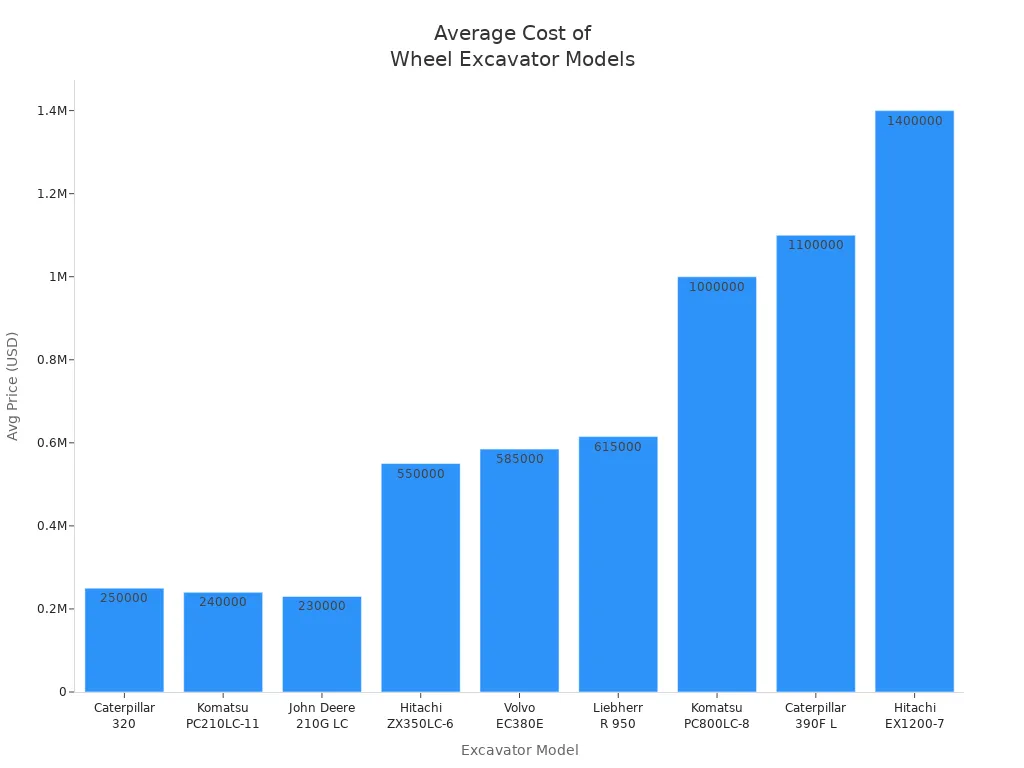
You should factor in operating costs, fuel efficiency, and maintenance when planning your budget. A long reach excavator may have a higher upfront price, but it delivers superior performance for specialized tasks. Investing in the right model reduces downtime and increases productivity throughout your construction project.
Consider these key points when budgeting:
Initial purchase price
Expected maintenance and repair costs
Fuel consumption rates
Availability and cost of attachments
Resale value
Alert: Choosing the right excavator type based on your budget and project needs ensures you maximize performance and avoid unexpected expenses.
By carefully assessing terrain, project size, and budget, you set the foundation for successful construction outcomes. The right wheel excavator delivers reliable performance and supports every phase of your project, from site preparation to final grading.
Selection Criteria for Wheel Excavators
Choosing the right wheeled excavator for your project requires a careful look at several key criteria. You need to evaluate machine size, attachments, mobility, fuel efficiency, and operator safety. Each factor impacts your productivity, cost, and long-term satisfaction. A reputable wheel excavator manufacturer, such as Jiangsu Tianhengweiye Construction Machine Co., Ltd in partnership with Hyundai, can help you navigate these choices with confidence.
Size and Operating Weight
You must match the size and operating weight of your wheeled excavator to your project¡¯s demands. Larger machines offer more power and reach, but compact models excel in tight urban spaces. The operating weight affects how the equipment interacts with the ground. Wheeled excavators distribute weight more evenly than tracked machines, which helps protect delicate surfaces like pavement and landscaped areas. This feature proves essential for city projects or sites with strict surface protection rules.
Wheeled excavators minimize surface damage, making them ideal for residential and municipal work.
Even weight distribution reduces the risk of rutting or cracking finished surfaces.
You can operate efficiently in areas with load restrictions or sensitive ground conditions.
Tip: Always check the machine¡¯s engine power and boom length. For most urban jobs, a boom length between 15 and 18 feet offers a good balance between reach and maneuverability.
Criteria | Description |
|---|---|
Engine Power | Affects efficiency and speed; models range from 50 to 150 horsepower. |
Boom Length | Longer booms reach farther but may reduce maneuverability; optimal length is often 15 to 18 feet. |
Size and Maneuverability | Critical in urban settings; compact machines navigate tight spaces better. |
Attachments and Versatility
The right attachments transform your wheeled excavator into a multi-purpose tool. You can switch between digging, grading, demolition, and material handling with ease. Leading wheel excavator manufacturers, like Tianhengweiye, offer a wide range of genuine attachments and customization options to suit your specific needs.
Buckets: Choose from standard, tooth, grading, rock, light material, and ditching buckets for different tasks.
Hydraulic breakers: Tackle demolition jobs by breaking concrete, asphalt, or rock.
Grapples and thumbs: Handle logs, debris, and demolition waste with precision.
Tiltrotators: Add 360-degree rotation and tilt for complex grading or trenching.
Quick couplers: Change attachments quickly and safely, reducing downtime.
Note: Always confirm attachment compatibility and weight limits with your wheel excavator manufacturer. Customization ensures your equipment meets the demands of each project.
Mobility and Transport
Mobility sets wheeled excavators apart from other equipment. You can drive them between job sites without a trailer for short distances, saving time and logistics costs. When you need to transport your equipment over longer distances, consider several factors:
Logistics: Efficient coordination from the wheel excavator manufacturer ensures timely delivery.
Handling equipment: Specialized machinery is necessary for safe loading and unloading.
Packaging: Proper protection prevents damage during transit.
Cost: Evaluate shipping methods for the best value.
Accessibility: Make sure docks and warehouses can handle oversized equipment.
Environmental impact: Choose transport options that meet sustainability standards.
Alert: Reliable manufacturers like Tianhengweiye maintain a robust logistics network, ensuring your wheeled excavator arrives safely and on schedule.
Fuel Efficiency and Maintenance
Fuel efficiency directly affects your operating costs. Modern wheeled excavators from top brands use advanced hydraulic systems and smart technologies to reduce fuel consumption. For example, hybrid models from Komatsu can cut fuel use by up to 30 percent, while Volvo¡¯s HVO100-compatible engines lower carbon emissions by 90 percent.
Manufacturer | Models/Technologies | Fuel Efficiency Features |
|---|---|---|
Caterpillar | Cat M320, M322 | Smart features optimize fuel consumption; advanced hydraulic technology integrated. |
Komatsu | Hybrid HB215LC-3, HB365LC-3 | Achieves 30% reduction in fuel consumption compared to older models. |
Volvo CE | EWR150E, EW240E; HVO100-compatible engines | 90% reduction in carbon emissions; electrification and automation for efficiency. |
Liebherr | A 913 Compact Litronic, A 924 Litronic | Energy recuperation systems enhance efficiency; hydrogen-powered models by 2030. |
XCMG | XE series (planned for 2025) | Fully electric wheel excavators; logistics center for faster shipment in Europe. |
JCB | Compact wheel excavators | Focus on urban construction; enhanced dealer network for better service and support. |
You should also consider maintenance support. A reputable wheel excavator manufacturer, such as Tianhengweiye, provides genuine parts and expert service. This ensures your equipment stays in top condition and reduces downtime.
Operator Comfort and Safety
Operator well-being impacts productivity and job site safety. Modern wheeled excavators include ergonomic controls, climate-controlled cabs, and advanced safety features. You should look for equipment with ROPS (Roll-Over Protective Structure), FOPS (Falling Object Protective Structure), and TOPS (Tip-Over Protective Structure) certifications.
Safety Feature | Contribution to Operator Well-Being |
|---|---|
Ergonomic controls | Reduces physical strain, helping operators remain alert and responsive, thus minimizing the risk of accidents. |
ROPS, FOPS and TOPS certifications | Provides protection during rollovers and falling objects, significantly enhancing safety in hazardous situations. |
Zero Tail Swing for Work in Confined Spaces | Prevents accidents in tight areas by eliminating the risk of striking nearby workers or structures. |
Modern Cameras and Travel Alarms | Enhances visibility and awareness around the machine, reducing the likelihood of struck-by injuries on job sites. |
Tip: Choose a wheel excavator manufacturer that prioritizes operator safety and comfort. Tianhengweiye, in partnership with Hyundai, delivers equipment with advanced safety systems and ergonomic designs.
Why Manufacturer Reputation Matters
Selecting a reputable wheel excavator manufacturer gives you access to genuine parts, high-quality service, and tailored customization. Tianhengweiye stands out for its partnership with Hyundai, offering a wide range of wheeled excavators and specialized equipment. You benefit from direct factory supply, a large inventory of genuine parts, and a proven track record of customer satisfaction. Customization options ensure your equipment matches your project¡¯s unique requirements.
Note: Always verify the manufacturer¡¯s service network and parts availability. Reliable after-sales support keeps your wheeled excavator running smoothly and extends its lifespan.
By focusing on these selection criteria, you ensure your investment in a wheeled excavator delivers maximum value, efficiency, and safety for every project.
Choosing a Wheel Excavator Manufacturer
What to Look for in a Manufacturer
You need to choose a manufacturer that matches your project¡¯s demands and supports your long-term goals. The right partner helps you maximize efficiency and minimize downtime. When you evaluate manufacturers, focus on these key factors:
Mobility: Select a manufacturer that offers wheel excavators with strong mobility. You want machines that travel quickly between job sites without a trailer.
Maintenance Support: Reliable after-sales service and preventive maintenance keep your equipment running. Look for companies that provide timely technical support and genuine parts.
Attachment Versatility: Choose a manufacturer that supplies a wide range of attachments. This flexibility lets you adapt your excavator to different tasks.
Stability and Safety: Outriggers and advanced safety features ensure your machine remains stable, even during heavy-duty work.
Ground Adaptability: Make sure the manufacturer understands the ground conditions you face. The right machine should perform well in your specific environment.
Tip: Manufacturers who listen to customer feedback and introduce new technologies often deliver better products and service.
Key Factor | Description |
|---|---|
Innovation | Leading brands introduce new technologies and design concepts. |
Customer Feedback Integration | Top manufacturers improve products based on user suggestions. |
Efficient After-Sales Service | Fast on-site support and technical help boost your satisfaction and reduce downtime. |
Why Tianhengweiye Stands Out
Jiangsu Tianhengweiye Construction Machine Co., Ltd sets itself apart as a trusted leader in the industry. You benefit from their 25 years of experience and strong partnership with Hyundai, a global name in construction machinery. Tianhengweiye specializes in both standard and customized Hyundai excavators, including pile drivers, amphibious models, and demolition machines. This wide product range ensures you find the right fit for any project.
Feature | Details |
|---|---|
Product Range | Specializes in Hyundai excavators and a variety of construction equipment. |
Customization Options | Offers modifications for special equipment, such as pile drivers and demolition machines. |
Service Capabilities | Provides after-sales service, technical support, and financial assistance. |
Market Focus | Serves municipal projects, real estate, and port operations. |
You also gain peace of mind from Tianhengweiye¡¯s commitment to quality. The company maintains a large inventory of genuine Hyundai parts and operates 50 branches for fast service. Their technical team responds quickly, helping you avoid costly delays. With a proven record of customer satisfaction and industry awards, Tianhengweiye gives you the confidence to focus on your business while they handle your equipment needs.
Practical Guide and Checklist
Step-by-Step Selection Process
You can simplify your decision-making by following a structured process. Start by identifying your project¡¯s main requirements. Evaluate the terrain, space, and type of work. Next, review the technical specifications of available wheel excavators. Focus on engine power, size, and maneuverability. Assess which attachments you need for your tasks. Always check for advanced safety features that protect both the operator and the job site.
Specification | Importance |
|---|---|
Engine Power | A robust engine provides better torque for demanding tasks. |
Attachments | The right attachments enhance versatility and efficiency for specific tasks. |
Size and Maneuverability | Affects the machine's ability to operate in various site conditions. |
Safety Features | Essential for ensuring operator and site safety during operations. |
Evaluate engine type, such as diesel or electric, based on your project needs.
Consider fuel consumption and operational costs.
Assess the compatibility of attachments with the excavator.
Tip: Always request a demonstration or trial to see how the machine performs in real conditions.
Common Mistakes to Avoid
Many buyers overlook key factors during selection. You should avoid these common mistakes:
Ignoring the importance of matching machine size to site constraints.
Overlooking attachment compatibility, which can limit your machine¡¯s usefulness.
Focusing only on price and not considering long-term operational costs.
Neglecting to verify the manufacturer¡¯s after-sales support and parts availability.
Skipping safety feature checks, which can compromise site safety.
Alert: Rushing your decision may lead to higher costs and reduced productivity.
Final Decision Checklist
Before you finalize your purchase, review this checklist to ensure you have covered all critical points:
Item Type | Description |
|---|---|
Inspection Points | Verify inspection reports before finalizing purchases. |
Financial Considerations | Assess brand reputation for resale value and parts availability. |
Safety Measures | Ensure the excavator meets safety standards and regulations. |
Brand Considerations | Choose brands known for durability and support, such as Tianhengweiye. |
Note: A thorough checklist helps you secure the best value and performance for your investment.
You can make the best choice for your project by following a clear selection process. Match the wheel excavator type and brand to your job requirements. Consider ease of maintenance, such as ground-level service points and modern diagnostic systems. Use a proactive maintenance schedule to protect performance and resale value. Review the checklist before you decide. Consult reputable manufacturers like Tianhengweiye for expert support and reliable equipment.
Align machine features with project needs
Prioritize reputable brands with strong service networks
Maintain your equipment for long-term value
FAQ
What are the main applications for wheel excavators?
You use wheel excavators for roadwork, utilities, and urban excavation. These machines excel in municipal projects, landscaping, and demolition. You benefit from their speed and flexibility on construction sites. Wheel excavators support a wide range of excavation applications, making them essential for many industries.
How do mini excavators differ from standard models?
Mini excavators offer compact size and easy maneuverability. You operate them in tight spaces where larger excavators cannot fit. These machines handle light excavation, landscaping, and small utilities projects. Mini excavators provide efficient performance for residential and urban construction sites.
What features should you prioritize for optimal excavator performance?
You should focus on engine power, advanced hydraulic systems, and attachment compatibility. Operator comfort and safety features also matter. These excavator features improve productivity and reduce downtime. Reliable after-sales support ensures consistent excavator performance on all excavation projects.
How does a wheeled excavator work on different terrains?
A wheeled excavator uses rubber tires for smooth travel on paved roads and hard surfaces. Outriggers add stability during excavation. You can move quickly between construction sites. For soft or uneven ground, you may need additional support to maintain safe operation and effective excavation.
What are some popular excavator uses in heavy equipment and utilities?
You use excavators for trenching, grading, demolition, and material handling. In utilities, excavators dig trenches for pipes and cables. Heavy equipment operators rely on excavators for site preparation and large-scale excavation. These machines adapt to many applications, making them valuable on diverse construction sites.


