


2026 Hyundai Excavator Guide: Match HX & HW Models to Jobs
 Sep 21, 2026|
 View:15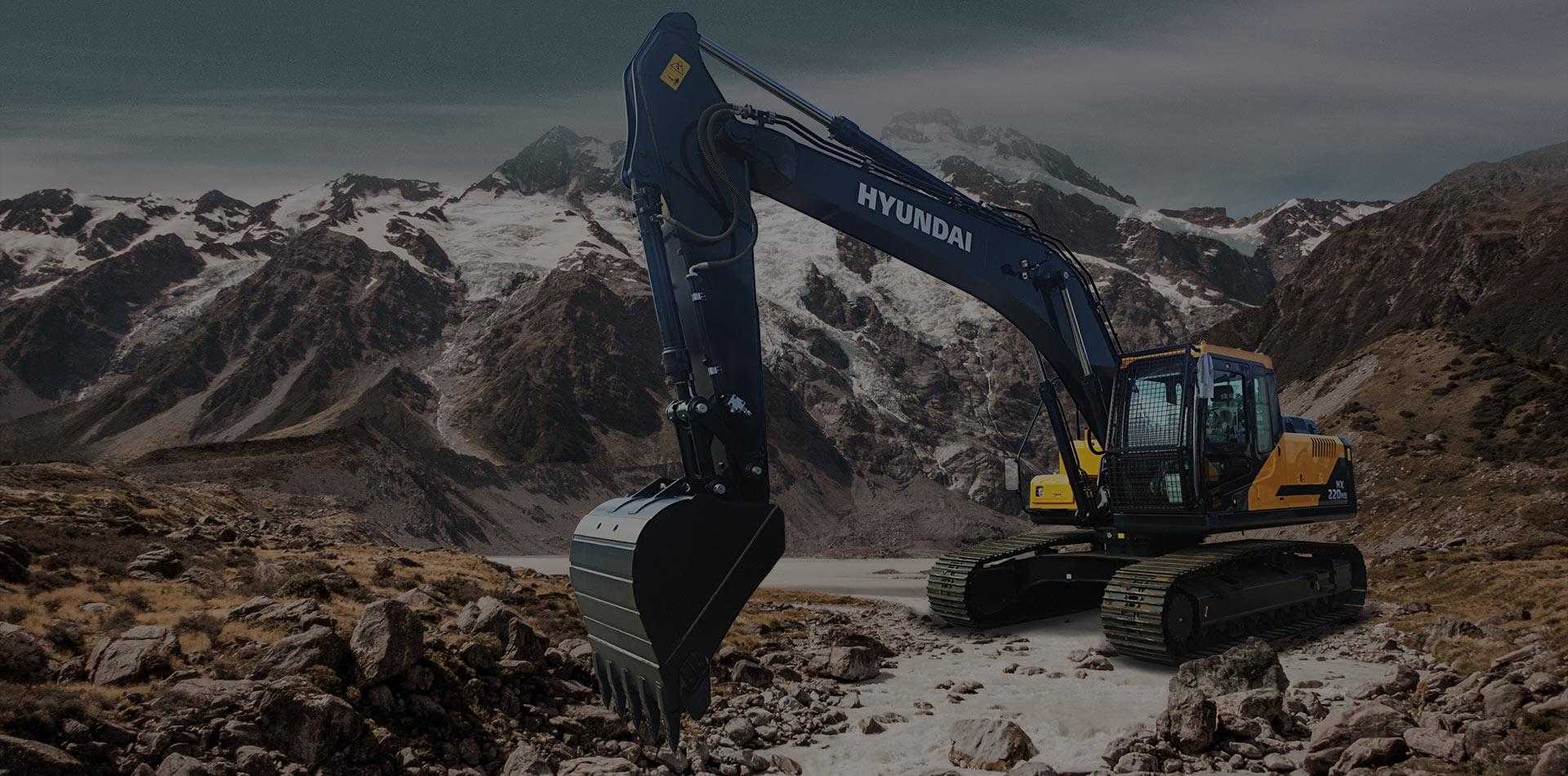
Hyundai's next-generation HX line arrived at CONEXPO 2026 with five models, HX230 through HX400, and a sixth, the HX210, following in North America later this year, according to Hyundai's own launch announcement. Hyundai's 2026 product expansion adds a second dedicated demolition model above the HX400L. This Hyundai excavator selection guide covers the seven standard models plus the amphibious, pile-driver and demolition configurations, judged on three variables: job class, site mobility and attachment fit. The central trade-off is relocation speed and ground bearing against digging stability and reach. This is a research-only comparison. Official specifications are attributed to Hyundai-owned product pages and brochures and dated where retrieved; figures that could only be sourced to the brand's commercial catalog are flagged as unverified so you can weigh them accordingly.
Key Takeaways
Hyundai's 2026 lineup spans seven standard models plus three factory-modified configurations, so the first decision is job class, not brand.
Crawler and wheeled undercarriages trade digging stability for relocation speed; the right answer depends on how often the machine moves.
Factory-modified units (amphibious, pile-driver, demolition) are specified against the work, not the catalog, and should be evaluated on their own terms.
This guide is published by Jiangsu Tianhengweiye Construction Machine Co., Ltd, established in 1999 and a Hyundai Construction Equipment partner for 25 years, including service as the company's designated modification partner for special equipment. Its work covers Hyundai crawler and wheeled machines as well as factory-modified configurations such as amphibious excavators and pile drivers, which is the basis for the model-to-job-condition matching described here.
That experience is hands-on, not catalog-based. On a cross-border pile-driving project in Guyana, South America, the site conditions were harsh and resources were scarce, and the customer needed the machine on site as fast as possible. The configuration pairing was a Hyundai carrier with a Tianheng-customized pile-driver package rated for 12 to 24 m steel sheet piles. The company dispatched an engineer, Zhao Xu, to support the build on location; working around constrained resources and long hours, he completed the on-site assembly and commissioning ahead of schedule, keeping the overseas project on its start date. It is the kind of configuration where a catalogued base machine plus a documented modification scope and on-site engineering support is the difference between a launch on time and a launch delayed.
The same standby model shows up in extreme conditions. During the 2021 Yellow River autumn flood, levees sat under sustained high water, and piping and seepage incidents broke out along the embankment. The response sites were mostly deep-water silt and mudflats where ordinary machines bog down and stall, and the work ran around the clock on riprap reinforcement, earthworks and desilting. Tianheng deployed a cluster of Hyundai 22-tonne crawler excavators (the HX225L / R225LC series), chosen for the stability of their hydraulics and their traction in mud, and kept a service engineer team on-site in continuous standby support. Across an environment of mud and standing water, the rescue fleet ran with zero unplanned downtime and completed the levee reinforcement work on schedule — a working demonstration of how these machines hold up under extreme duty and what an on-site parts-and-service commitment looks like in practice.
Those two projects are backed by a track record you can check. Tianheng holds Hyundai's Service & Parts Diamond-Level Dealer status for 15 consecutive years, and has been the brand's top seller of whole machines and parts over the same span, with cumulative sales past 20,000 units. The company also built Hyundai's first special-equipment unit anywhere in the world — a milestone spanning pile drivers, electric demolition machines, floating (amphibious) excavators and demolition rigs — which is why a modified Hyundai ordered from Tianheng starts from factory-level engineering rather than an aftermarket retrofit. As one of Hyundai's core China-market partners, chairman Shang Jun has represented the dealer network at the manufacturer's Global Dealer Meeting in Türkiye, and company executives have been the sole dealer representative at Hyundai's official technical training and annual dealer conferences. For a buyer evaluating a supplier, that combination — diamond-level service certification, verified sales scale and a first-of-its-kind modification record — is the evidence behind the guidance in this article.
Hyundai Excavator Selection Guide: The Three Variables That Decide the Model
Excavator model to job condition matching comes down to three variables, and they are settled before any model number enters the conversation: job class, site mobility, and attachment fit.
Job class starts with the bucket. The practical rule puts it plainly: identify the loose density of the heaviest material you typically move, then choose a machine that can handle that bucket and load, not the other way around. Stick length follows, since shorter sticks deliver more digging power while longer sticks trade force for reach. Counterweight belongs in the same pass, not as an afterthought: the bucket-first rule treats it as a selection variable to check alongside stick and roller frame.
Site mobility separates one-pit work from dispersed sites, where road travel changes the calculus against trailer transport. Attachment fit is the third gate: breaker and hammer circuits only work when carrier flow and operating pressure match the attachment's range, and the machine must support a free-flow return or case drain line where the attachment requires one, since blocking a case drain can damage seals.
Running the numbers behind each gate
The three variables are not just qualitative; each one resolves into a figure you can check before you order.
Hydraulic flow and pressure matching
A carrier's main pumps deliver a rated flow at a defined implement-circuit pressure — the official HX220HD page lists 2 × 234 L/min at 350 kgf/cm², for example. An attachment with a higher flow or pressure demand than the carrier can supply will run slow or stall; one with a much lower demand wastes the carrier's capacity. The safe move is to match the attachment's continuous flow and working-pressure requirements inside the carrier's rated band, not at its peak, and to confirm the relief setting. Where a hammer or shear specifies a case-drain return, that line must be plumbed to tank — not blocked — or the attachment's seals overheat and fail.
Ground pressure estimation
Ground pressure decides whether a machine can work on soft or sensitive ground, and it is estimable before purchase. Take the machine's operating weight in kilograms and divide by the total ground-contact area of both tracks (track width × track-on-ground length × 2, in the same units) to get a pressure figure, then compare it to the site's bearing capacity. A 21.4 t HX220HD on wide, long tracks spreads its load over a larger footprint than a comparable wheeled machine, which is why tracked machines are the default where bearing capacity is low. Track shoes and pads can be swapped to raise the contact area further when the ground is marginal.
Bucket volume versus loose density
Bucket capacity is a volume rating, not a mass rating, so the material's loose bulk density is what converts one into the other. Multiply the bucket's struck capacity by the material's loose bulk density to estimate the payload mass per cycle, then check that figure against the machine's rated lifting and breakout capability. Two buckets of equal nominal volume can represent very different masses — a dense, wet material will fill and weigh far more than dry, loose spoil. When the heaviest material is dense, size down the bucket rather than overload the machine.
Key Takeaway: Define your job class in three questions before comparing models. What is the loose density of your heaviest material? Does the machine travel between sites or stay in one pit? Which attachment will it run, and does the carrier's hydraulic circuit support it?
Quick Comparison Table: The 2026 Hyundai Lineup at a Glance
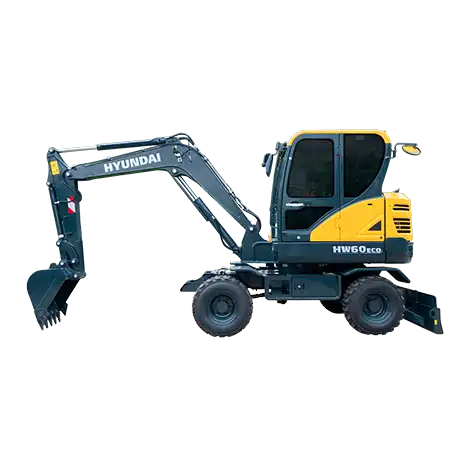
The table below separates official Hyundai data (verified against Hyundai-owned product pages and brochures) from brand commercial-catalog values (unverified), so you can see which figures carry what level of evidence. Where the two sources disagreed, the official Hyundai value is used and the deviation is noted.
Model | Class | Operating weight | Rated power | Bucket capacity | Emissions tier | Source status |
|---|---|---|---|---|---|---|
HX60PRO | Mini | 5.67 t | 36.2 kW @ 2,200 rpm | 0.21 m³ | T4 | Brand catalog — closest official sibling HX60G (HD Hyundai official PDF) shows 5.85 t / 36.2 kW gross (34.4 kW net) @ 2,100 rpm / 0.25 m³ |
HX80 | Mini | 7.34 t | 36.2 kW @ 2,200 rpm | 0.32 m³ | T4 | Brand catalog — closest official sibling HX80G (HD Hyundai official PDF) shows 7.54 t / 46.3 kW gross (44.1 kW net) @ 2,200 rpm / 0.28 m³ / Tier 2 |
HX130 | Medium | 12.5 t | 89 kW @ 2,200 rpm | 0.52 m³ | T4 | Brand catalog — closest official sibling HX130A LCR (Hyundai CE official brochure) shows 13.445 t / 54 kW net (55 kW gross) @ 2,200 rpm / 0.50–0.61 m³ / EU Stage V |
HX220HD | Heavy | 21.4 t | 110 kW @ 2,000 rpm | 0.87–1.2 m³ | Tier 2 | Official — Hyundai CE product page, HX220HD (21.4 t / 110 kW / 0.87–1.2 m³ / Tier 2); catalog listed 21.42 t |
HX340HD | Heavy | 33.0 t | 190 kW net (194 kW gross) @ 2,200 rpm | 1.74 m³ | Tier 2 | Official — Hyundai HX340HD brochure (33,000 kg / 190 kW net / 1.74 m³ / Tier 2); corrected from catalog's 194 kW / 1.44 m³ |
HW60ECO | Mini (wheeled) | 5.65 t | 36.2 kW @ 2,200 rpm | 0.18 m³ | T4 | Brand catalog — closest official sibling HW60A+ (Hyundai CE official PDF) shows 6.05 t (6.30 t on double tires) / 49.9 kW @ 2,400 rpm / 0.18 m³ / EU Stage V |
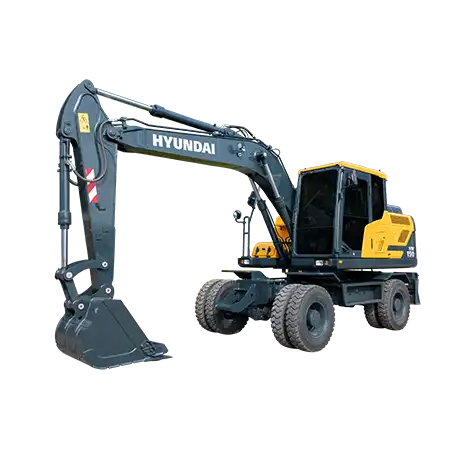
HW150 | Medium (wheeled) | 13.74 t | 125 kW @ 2,200 rpm | 0.58 m³ | T4 | Brand catalog — closest official sibling HW150A CR (Hyundai CE official page) shows 17.17 t / 128 kW @ 2,200 rpm / 0.58–0.71 m³ / EU Stage V |
Three verification notes belong with the numbers.
First, the HX220HD and HX340HD rows are sourced directly to Hyundai-owned pages: the HX220HD product page (retrieved 2026-09-21) and the HX340HD brochure (retrieved 2026-09-21). The HX340HD correction matters most — the earlier catalog figure of 1.44 m³ matches the HX340 SL variant, while the HX340HD brochure lists 1.74 m³, and the 194 kW figure is gross power, not the 190 kW net rating.
Second, the five remaining rows carry brand commercial-catalog values, but each is now matched to its closest official Hyundai sibling, documented to a Hyundai-owned PDF or product page, so the deviation is visible at a glance: the HX60PRO against the HX60G/HX80G official PDF (5,850 kg / 36.2 kW gross / 34.4 kW net @ 2,100 rpm / 0.25 m³), the HX80 against the same HD Hyundai HX60G/HX80G PDF (7,540 kg / 46.3 kW gross / 44.1 kW net @ 2,200 rpm / 0.28 m³), the HX130 against the HX130A LCR official brochure (13,445 kg / 54 kW net / 55 kW gross / 0.50–0.61 m³ / Stage V), the HW60ECO against the HW60A+ official PDF (6,050 kg / 49.9 kW @ 2,400 rpm / 0.18 m³ / Stage V), and the HW150 against the HW150A CR product page (17.17 t / 128 kW @ 2,200 rpm / 0.58–0.71 m³ / Stage V). Treat these catalog rows as pending verification rather than confirmed data, because the official sibling is not always a like-for-like equivalent — the HW150 catalog figure of 13.74 t sits well below the official HW150A CR's 17.17 t, which points to a different generation or market version rather than a rounding difference.
Third, always have your dealer confirm the exact configuration against an official Hyundai spec sheet before committing, since regional product pages can carry different model suffixes and emissions labels.
Which Hyundai Excavator Fits Which Job Class?
Match the machine to the work, not to the price tag. The standard crawler line splits into five practical bands, and each band exists because breakout force, reach and transport weight trade off against each other.
Run the three variables as a single path rather than three separate checks. The table below turns job class, site mobility and attachment fit into a walk-through you can complete before you talk to a dealer.
Step | Question to answer | If yes | If no |
|---|---|---|---|
1. Material | Is your heaviest material dense or wet (high loose density)? | Size down the bucket; prioritize breakout force | Standard bucket is fine; prioritize reach |
2. Setup | Do you dig deep from one setup? | Longer stick; crawler undercarriage | Shorter stick; consider wheeled |
3. Relocation | Does the machine travel between sites on roads? | Wheeled (HW60ECO, HW150) | Crawler (HX60PRO through HX340HD) |
4. Ground | Is bearing capacity low, soft or wet? | Crawler with wide track shoes; check ground pressure | Ground pressure less critical |
5. Attachment | Will it run a breaker, shear or hammer? | Confirm carrier flow, pressure and case-drain line | Standard digging configuration |
6. Special duty | Does the work need flotation, piling or demolition? | Factory-modified build; confirm scope and warranty | Standard machine |
Work the rows in order: each answer narrows the band before you reach the model number, and the last two rows decide whether a standard machine is even the right starting point.
Mini class (5.67 to 7.34 t): the HX60PRO and HX80 handle confined utility work, trenching and residential site prep. Their 36.2 kW engines and 0.21 to 0.32 m³ buckets suit short cycles in tight access, and both stay under the transport weight that lets a standard lowboy move them without permits.
Medium class (12.5 t): the HX130 covers general earthwork and medium trench at 89 kW and a 0.52 m³ bucket, the point where reach stops limiting how deep a single setup can dig.
Heavy class (21.4 to 33 t): the HX220HD takes heavy bulk excavation and truck loading at 110 kW and 0.87 to 1.2 m³, while the HX340HD moves to mass excavation, quarry work and large-scale site prep at 190 kW net (194 kW gross) and a 1.74 m³ bucket. The HX220HD vs HX340HD decision usually turns on haul-road geometry and permitted transport width rather than digging power alone.
Crawler or Wheeled: HX220HD vs HW150 and the Rest of the Line
Crawlers win on stability under digging load; wheeled units win on relocation. Hyundai's own comparison of tracked and wheeled machines puts it plainly: crawlers are "slower than wheeled excavators" but deliver "overall greater stability," while a wheeled machine "can be driven from one job site to another by wheels easily on a road," whereas crawler excavators "are generally transported on a trailer for even a short distance travel" (Hyundai CE India, 2021-12-10).
That single transport difference drives most fleet decisions. Hyundai's wheeled excavator applications center on earthwork, utility work, construction site projects and street maintenance, with high ground clearance and easy maneuverability in confined spaces; the same source notes they excel in urban areas (Hyundai CE India, 2021-12-10). Tracked machines are built for digging, loading, earthmoving, grading, lifting and carrying, and their track system lets them scale and descend hills with less risk, which suits grading hilly areas and uneven terrain (Hyundai CE India, 2021-12-10).
Wheeled is not automatically the small option. The Hyundai wheeled excavator HW150 sits at 13.74 t with a 0.58 m³ bucket, above the 12.5 t HX130 crawler, while the HW60ECO (5.65 t) pairs against the HX60PRO. Match on undercarriage first, then size.
Decision factor | Crawler (HX130, HX220HD) | Wheeled (HW60ECO, HW150) |
|---|---|---|
Relocation between sites | Trailered, even short moves | Driven on road on its own wheels |
Road travel | Not intended | Supported |
Soft-ground bearing | Tracks spread load | Higher ground pressure risk |
Confined maneuverability | Limited | High, with ground clearance |
Stability under load | Greater | Lower |
Factory-Modified Configurations: Amphibious, Pile-Driver and Demolition
Three configurations sit outside the standard HX and HW line, and each carries a scope limit you should confirm before signing anything.
For dredging and wetland or marsh work where flotation is required, the amphibious configuration listing replaces conventional steel crawler tracks with large pontoon-style tracked floats, which is the basis of any Hyundai amphibious excavator enquiry. The pile-driver specification supports steel piles of 12 to 24 m for municipal, subway, real-estate and port projects, but Hyundai's own catalog units are shown at 0 to 21 m and 0 to 18 m. Piles beyond those ranges imply a customized, heavier-duty build rather than a catalogued machine.
Demolition carriers take hydraulic shear or pulverizer attachments, and the demolition model above the HX400L announced in Hyundai's 2026 product expansion adds a second dedicated unit with purpose-built booms.
⚠️ Warning: Confirm the pile length your project needs against the catalogued range before quoting. A 12 to 24 m requirement may not be a standard catalog build.
Modification warranty status and parts support are verification items, not guarantees: ask the dealer to state in writing which components the modification covers and which supplier services them.
Emissions Tier, Transport Limits and the 2026 Next-Gen Overlap
Emissions tier decides where a machine can legally work and what it is worth when you sell it. In the current lineup, the HX60PRO, HX80, HX130, HW60ECO and HW150 carry T4 designations, while the HX220HD and HX340HD are listed as T2. That split is the single most consequential line in this Hyundai excavator selection guide for buyers working across regional or municipal contracts: a T2 machine can be restricted from certain urban and publicly funded sites, and it typically resells into a narrower pool.
The forward-looking half of the decision is the next-generation HX family. Hyundai launched five models at the 2026 CONEXPO launch (HX230L, HX260L, HX300L, HX360L and HX400L), with a sixth, the HX210, to follow in North America later in 2026, according to Hyundai North America's launch announcement. The company states the new platforms deliver at least 22% more productivity and roughly 9% to 10% better fuel efficiency, and extend oil and filter intervals from 500 to 1,000 hours. Treat that as Hyundai's stated productivity claim: no baseline, test conditions or measurement method is published, so it is not a figure you can put in a procurement comparison.
The ladder itself is concrete. Per the next-gen HX lineup page, the HX230L runs 139 kW at 23,705 kg with a 0.92 m³ bucket, the HX260L 169 kW at 26,370 kg, the HX300L 207 kW at 33,020 kg, the HX360L 224 kW at 37,060 kg and the HX400L 251 kW at 41,840 kg. The gap that matters sits at 30 to 35 t: the current HX340HD has no direct next-gen replacement listed yet, so a buyer in that class is choosing between a proven T2 machine available now and an incoming Stage V platform. Hyundai's 2026 product expansion confirms Stage V compliance and a second demolition model, but not a like-for-like HX340HD successor.
Red Flags and Deal-Breakers Before You Commit
Four criteria are must-haves, not preferences. Get any of them wrong and the machine will underperform on the job it was bought for.
Bucket sized to loose density, not catalog volume. A 0.87 to 1.2 m³ bucket on the HX220HD is rated for general digging. If your heaviest material is dense or wet, size the bucket against loose density and accept a smaller nominal volume.
Stick length matched to reach versus force. Long sticks trade breakout force for reach. Decide which the job needs before you order.
Confirmed breaker flow and pressure, plus a case-drain provision. Without a documented case-drain return, a hammer circuit runs hot and voids attachment coverage.
Transport weight and width checked against the routes the machine will actually travel. A machine that cannot move legally between sites is not a working asset.
Three things disqualify a supplier outright. A spec sheet that cannot be reconciled to an official source is the first: the model catalog used throughout this guide is the brand's own commercial document, not Hyundai's official specification sheet, and any figure that cannot be traced to a Hyundai-owned page should be treated as unconfirmed. A factory modification quoted with no stated warranty position is the second. A pile length beyond the catalogued 12 to 24 m range, presented as standard, is the third.
Key Takeaway: Match the excavator model to job condition on bucket density, stick length, breaker circuit and transport envelope first. Then verify every figure against an official source and every modification against a written warranty position before you commit.
For a modified configuration, request the specification brief and the written modification scope, then have the configuration confirmed against your job conditions before you sign.
Frequently Asked Questions
Is the HX220HD better than the HX340HD?
They are not competitors; they are different machine classes. The HX220HD is a 21.4 t unit with a 110 kW engine and a 0.87 to 1.2 m³ bucket (Hyundai CE product page), while the HX340HD is a 33 t unit rated at 190 kW net / 194 kW gross with a 1.74 m³ bucket (Hyundai HX340HD brochure). The HX220HD vs HX340HD question is really a job-class question: match the 21 t machine to general excavation and utility work, and step up to the 33 t class only when haul volume and reach justify the larger transport and site footprint.
Can a wheeled HW150 replace a crawler on a soft site?
Usually not. Hyundai's own comparison of tracked and wheeled machines notes that wheeled units trade flotation and traction for road speed, so a 13.74 t HW150 that travels between sites on its own wheels will struggle where ground bearing capacity is low. Keep the crawler for soft, uneven or wet ground; choose the wheeled machine when road mobility matters more than flotation.
Can a standard carrier be converted to amphibious or pile-driver duty?
These are factory-modified configurations rather than field conversions. The amphibious build uses a pontoon undercarriage for dredging and wetland work, and the pile-driver configuration is rated for 12 to 24 m steel piles in municipal, subway, real-estate and port projects, per the pile-driver specification. Confirm the modification scope and warranty position with the supplier before assuming a standard machine can be adapted.
Is the T2 HX220HD still worth buying in 2026?
It depends on where the machine will work, not on its age alone. T2 and T4 designations sit across the same catalog, and the next-generation overlap was visible at the 2026 CONEXPO launch, so a T2 HX220HD remains a practical option in markets where T2 is still accepted and the duty cycle suits a 21.4 t machine. Where local emissions rules or fleet standardization push you toward T4, the newer tier is the safer long-term buy.
Conclusion
The Hyundai excavator selection guide comes down to three variables: job class, site mobility and attachment fit. Everything else in this article is a way of measuring those three against a specification sheet.
Job class sets the size band. The crawler line runs from the 5.67 t HX60PRO through the 33 t HX340HD, with bucket capacities from 0.21 m³ to 1.74 m³. Match the band to the material moved per cycle, not to the largest machine the budget allows.
Site mobility decides crawler or wheeled. Crawlers carry the heavy end of the range; the wheeled line (HW60ECO, HW150) exists for sites where the machine has to move itself between jobs.
Attachment fit is a factory question, not an aftermarket one. Amphibious, pile-driver and demolition configurations are built as variants, so the attachment decision belongs in the specification stage.
Lifecycle framing beats purchase price. Emissions tier, transport limits and resale value are set at configuration, and none of them can be changed later at reasonable cost.
Next step: for the model class you have landed on, request the configuration brief and have the specification confirmed against your job conditions and an official Hyundai spec sheet before you commit. Figures marked as brand-catalog values in this guide should be treated as unverified until that confirmation.
Ready to confirm the right configuration for your job conditions? Send us your target model class, attachment list and destination market — our engineering team replies with the configuration brief and the written modification scope.
Recent News
1.Hyundai HX1000: The Ultimate Heavy-Duty Mining Excavator
2026-09-112.Hyundai HX135G 13.5-Ton Excavator Specs & Guide
2026-09-073.Hyundai HX220HD Excavator Review: Specs, Price & Reliability
2026-09-014.Hyundai 550 Excavator Review: The Pros and Cons for Construction
2026-08-105.Hyundai HX220PRO: China Stage IV 20-Ton Excavator for Efficient Work
2026-09-15


