


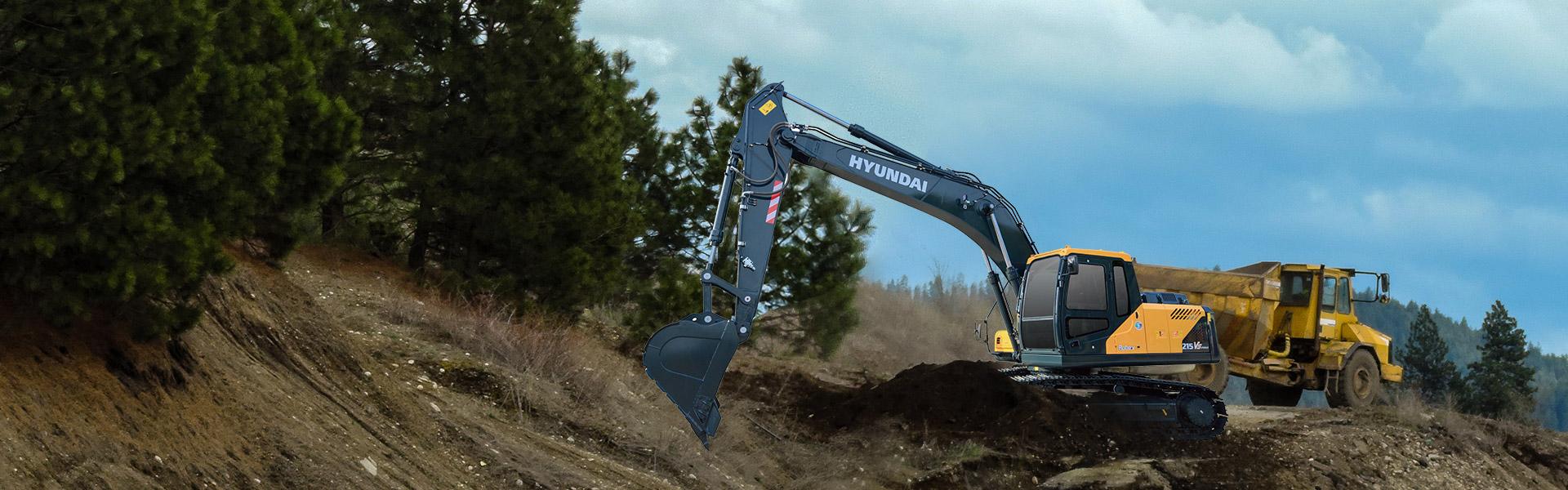
Crawler vs. Wheeled Excavator: Key Differences, Costs & Best Uses
 Nov 03, 2026|
 View:4
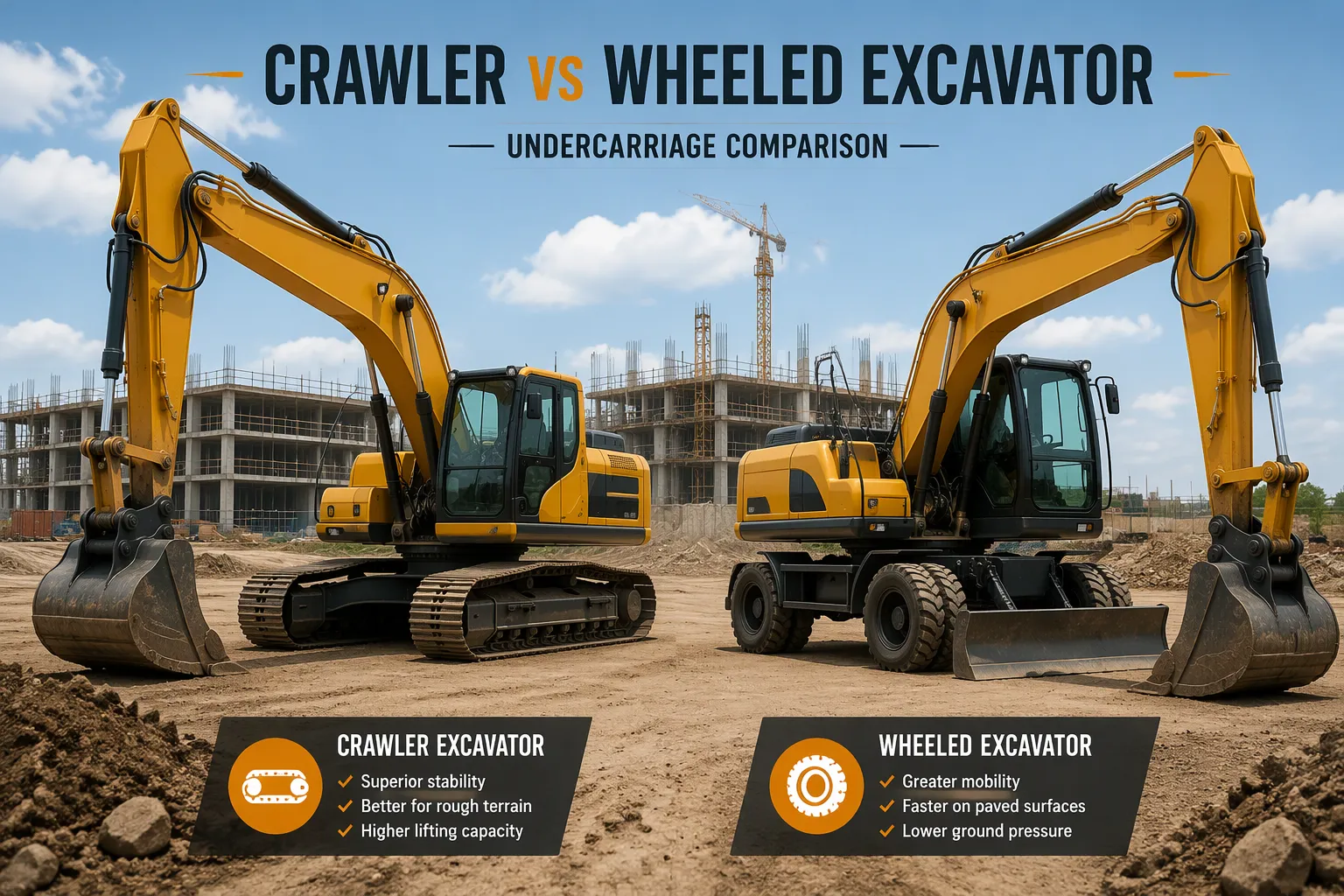
Crawler excavators excel on rough terrain and heavy-duty tasks. Steel or rubber tracks spread machine weight across a large contact area, which delivers strong traction and stability on soft, uneven, or sloped ground. Wheeled excavators offer superior mobility and speed on paved surfaces. A rubber-tired undercarriage lets the machine drive itself between sites, and modern models such as the Hyundai HW series wheeled excavators reach impressive top travel speeds for rapid site repositioning.
This crawler excavator vs. wheeled excavator comparison examines the practical factors that separate the two machine types. Mobility, terrain adaptability, stability, digging performance, operating costs, transport, and purchase price all shape the final decision. Matching machine type to the actual job remains the central question.
Key Takeaways
Crawler excavators excel on rough, soft, or sloped ground because tracks spread weight and provide strong traction.
Wheeled excavators travel fast on paved roads and move between sites without a trailer, saving time and transport costs.
Crawler excavators offer better stability and lifting capacity for heavy-duty tasks on uneven terrain.
Wheeled excavators cause less damage to asphalt and concrete, making them ideal for urban projects and finished surfaces.
Choose crawler excavators for long-term heavy work on soft ground; choose wheeled excavators for frequent moves on paved surfaces.
What Is a Crawler Excavator?
A crawler excavator carries the same boom, arm, and bucket as other excavator types, but the upper structure sits on a tracked undercarriage. Steel or rubber tracks replace wheels. This design spreads the machine's weight over a long, wide ground contact area. The result is strong traction and a low center of gravity, which suits work on soft, muddy, or uneven ground.
Tracked Undercarriage Basics
The undercarriage is a system of linked parts, and each part has a clear job. Industry maintenance guides highlight the main components:
Component | Function |
|---|---|
Final drive | The hydraulic motor and gearbox that turns the sprocket. |
Sprocket | Bolts to the final drive. Its teeth engage the links in the track to give the machine motion. |
Track chain | Links joined together by pins. The sprocket engages the links to transfer forward motion. |
Idler | Guides the link and holds the track at the correct tension, working with the track adjuster. |
Rollers | Bottom rollers run on the chain rail beneath the machine. Carrier rollers support the chain on its return run. |
Track adjuster | Sits in the frame between a bulkhead and the idler to keep the track correctly tensioned. |
Track shoe | The plate that meets the ground; the grouser is the raised bar on the shoe that grips it. |
Track rollers deserve a closer look. These rugged wheels support the machine's weight and guide the track chain over rough terrain. Single-flange rollers guide the track on one side, while double-flange versions provide dual support for enhanced stability.
Typical Crawler Work
Crawler machines fit jobs that reward traction and stability. Common tasks include:
Digging foundations, trenches, and pits
Loading trucks and hoppers
Demolition and debris removal
Material handling and placement
Landscaping and site preparation
Forestry and land clearing
Dredging and underwater excavation
These machines also handle mining, concrete and road construction, heavy excavation, lifting, deep foundation digging, and soft muddy areas where wheeled machines struggle. Long-term heavy-duty projects on uneven ground remain their home territory.
What Is a Wheeled Excavator?
A wheeled excavator carries the same boom, arm, and bucket as a crawler machine. The difference sits below the upper structure. A rubber-tired, road-going undercarriage replaces the tracks. This design lets the machine drive itself along paved roads and between job sites without a trailer. Wheeled units suit urban and crowded projects where fast repositioning matters more than raw traction.
Rubber-Tired Undercarriage Basics
The wheeled chassis swaps tracks for tires, axles, and final drives. Wheeled excavators feature specialized components such as heavy-duty axles, tires, brakes, steering systems, a dozer blade, and outriggers. Tire pressure, axle condition, and stabilizer integrity all affect safety, efficiency, and operating costs.
A typical wheeled undercarriage includes six tires, wheel bearings, axle seals, steering cylinders, and brake components. Tires generally last 3,000–5,000 hours, with replacement costs varying by size and ply rating. Axle and steering maintenance is typically required every 2,000 hours. Stabilizer outriggers or a dozer-blade stabilizer keep the chassis planted during digging cycles.
Typical Wheeled Work
Wheeled excavators fit firm, stable ground. They are exceptionally well-suited for urban construction, roadwork, and flat terrain. Their ability to move between job sites without a trailer saves significant time and transportation costs.
Roadside crews often use short-swing models in narrow lanes to reduce traffic disturbance. Utility teams swap an outrigger for a dozer blade or add a tilt rotator. Waste and scrap operations add guarding, solid tires, or a rotation grapple. A short-swing wheeled excavator can turn within one lane of traffic, making it a practical choice for tight quarters.
Mobility and Speed
Road Travel and Site-to-Site Movement
Travel speed separates the two machine types more sharply than any other factor. Industry comparisons summarize the gap clearly:
Feature | Crawler Excavator | Wheeled Excavator |
|---|---|---|
Top Speed | 3 – 6 km/h | 25 – 40 km/h |
A crawler machine creeps along at a walking pace. Moving it any real distance means loading it onto a trailer. A wheeled excavator, by contrast, can reach speeds of up to 30-40 km/h, so it drives itself between nearby sites and starts work on arrival.
Job Site Positioning
Positioning follows the same logic. A machine which digs and then relocates efficiently reduces idle time between individual work areas. A unit that produces slightly fewer tons per hour but spends far more time actually working can deliver better project productivity than equipment that needs frequent transport and setup.
Crawler excavators still hold their ground once they arrive. They provide strong flotation and stability on soft or highly uneven terrain, and they suit sites where the machine stays put for a long period. Wheeled units fit paved surfaces, municipal work, roadside excavation, utility installation, and clusters of nearby job sites.
Terrain Adaptability
Soft, Rough, and Sloped Ground
Crawler excavators hold a clear advantage on difficult ground. Large tracks provide better grip and balance on soft or uneven ground, such as muddy building sites or rocky terrain. The wide track footprint disperses machine weight and reduces ground strain. This flotation keeps the machine from sinking or getting stuck in weak soil.
Broad tracks hold weak soils together and minimize ground disturbance. That trait matters on extensive excavations in soft soil and on lifts over uneven ground.
Attribute | Track (Crawler) Excavators | Wheel Excavators |
|---|---|---|
Terrain | Ideal for rough, soft, or hilly surfaces | Best for road surfaces, urban areas |
Stability | Excellent for heavier loads | Less stable on uneven ground |
Wheeled machines lack stability on soft or unbalanced surfaces because those surfaces demand good traction. On soft or uneven ground, the wheeled unit may need outriggers for safe operation.
Paved and Finished Surfaces
Wheeled excavators perform best on firm, finished ground. The wheels allow faster movement and easier maneuvering on flat-surface worksites. The machine can cross finished surfaces without leaving marks or indentations, which suits street maintenance work.
Rubber tires protect the surface itself. Tires reduce damage to asphalt and concrete compared with tracks. The machine can dig and load without harming finished landscaping structures such as stone paving or brick surfaces.
Operators should still manage stability on these sites. Proper deployment of outriggers or the dozer blade keeps the machine planted during the digging cycle.
Stability and Ground Pressure
Lifting Stability on Crawlers
Tracked machines like the Hyundai HX220L carry a low center of gravity and a long ground contact base. Both traits resist tipping during a lift. Rated capacity depends on several lift chart variables:
Lift Chart Factor | Effect on Capacity |
|---|---|
Lift point height | Hoisting at higher elevations usually reduces capacity |
Over-front vs. over-side lifting | Lifting over the front provides greater stability than lifting over the side |
Lift radius | Greater horizontal distance from the centerline places more strain on the boom |
Machine configuration | Counterweights, undercarriage width, boom and stick length all affect ratings |
Real-world conditions matter as much as the chart. Soft or uneven ground can cause tipping or sinking. Heavier attachments shift the center of gravity away from the base, which reduces stability through increased leverage. Operators should work from the manufacturer's chart for their exact model and configuration.
Ground Bearing and Surface Protection
Ground pressure follows a simple physical rule. Pressure equals force divided by area, so spreading machine weight across a larger contact surface lowers the pressure on the ground. Tracks create one long contact patch instead of four small ones. Therefore, heavy-duty crawler excavators run at lower ground pressure than wheeled units, which concentrate weight on four tire points.
Track width tunes that pressure further. Wide shoes improve flotation on soft, muddy, or water-saturated ground and cause less disturbance to finished landscapes.
Surface protection cuts the other way. Steel tracks chew up asphalt, and even rubber tracks leave marks on pavement and create ruts in soft ground. Wheeled machines roll on rubber tires with minimal surface impact. Where a contract carries surface-repair penalties, the tracked machine becomes a liability.
Digging and Lifting Performance
Breakout Force and Digging Depth
Breakout force and digging depth describe what a machine can actually cut and reach. Typical figures for a standard 20 to 22 ton crawler excavator include:
Excavator type | Digging depth | Breakout force |
|---|---|---|
Standard 20 to 22 ton crawler | 6.5 to 7.2 meters | 16–20 tons at the bucket teeth |
These numbers give a useful baseline for matching machine size to trench depth and soil hardness. A project that needs deeper trenches or harder ground calls for a larger class of machine, not a different undercarriage.
Undercarriage type does not set digging performance on its own. Boom length, stick length, bucket size, and hydraulic pressure all shape the result. Crawlers hold traction on soft or uneven ground, so they sustain production through a full shift. Wheeled machines work best on stable surfaces where tire grip stays consistent.
Lift Charts and Safe Working Loads
Lifting capacity demands a disciplined approach. Capacity depends on configuration, load position, stability, and hydraulic factors. Operators should never infer a safe load from machine category, bucket size, or operating weight. The current model-specific lift chart for the intended lift-point height and radius is the only reliable source.
Undercarriage type is one part of the machine configuration, not a capacity rating. Crawlers generally offer better lifting capacity, since they are built for heavier-duty operations under pressure. That trait suits large-scale work such as demolition in open areas with continuous heavy handling. Wheeled units can still lift substantial loads when outriggers are deployed on level ground.
Maneuverability and Surface Impact
Tight Spaces and Confined Sites
Confined work zones reward a compact turning envelope. Wheeled excavators boast excellent maneuverability, which lets them easily move within tight spaces and work in confined areas. The tire undercarriage makes these machines significantly faster and much easier to maneuver on concrete, asphalt, and other flat surfaces. A wheeled unit can pivot, reposition, and exit a narrow lane without tearing up the ground beneath it.
Crawler machines handle confinement differently. Tracks give crawlers their maneuverability on rough and uneven surfaces. That advantage fades on a finished slab or a crowded city block. A tracked machine turns slowly and needs more room to swing its tail. On a tight urban lot, the wheeled excavator usually finishes the repositioning cycle first.
Road Damage and Cleanup Costs
Surface damage carries a real price on paved contracts. A wheeled excavator sits on heavy-duty rubber tires and can travel on paved roads without damaging the asphalt. That trait removes a common source of repair claims. Crews avoid patching costs, and the site reopens to traffic sooner.
Steel tracks leave a different footprint. Crawler undercarriages excel on soft ground, mud, gravel, or hilly terrain. Those same tracks can scar asphalt and concrete during a turn. Contractors then absorb milling, patching, and cleanup charges after the machine leaves. The wheeled machine's value is undeniable in environments dominated by concrete and asphalt, where maneuverability is paramount.
Fuel and Operating Costs
Travel Fuel Consumption
Track friction shapes the fuel bill before the bucket ever touches soil. Crawler excavators tend to consume more fuel than wheeled excavators because their tracks generate friction. On smooth surfaces, the tracked machine can be the less efficient option. Rubber tires roll with lower resistance, so a wheeled unit burns less fuel during transport between job sites.
The gap narrows once the machine starts digging. Industry data breaks the difference down by duty cycle:
Condition | Fuel Consumption Comparison |
|---|---|
Traveling or maneuvering | Crawler excavator burns more fuel due to higher rolling resistance of tracks |
Pure digging | Difference narrows; friction in track chain and bottom rollers adds about 5–10% parasitic loss |
Mixed cycle (digging, swinging, moving) | Wheeled units typically consume 10–15% less fuel per hour than similarly powered crawlers |
Extensive high-load digging | Crawlers may finish sooner, offsetting the hourly advantage |
The last row deserves attention. A crawler that completes a heavy cut faster can erase the wheeled machine's hourly fuel edge over the life of the task. Fuel cost per cubic meter, not fuel cost per hour, tells the truer story.
Daily Operating Cost Factors
Fuel is only one line on the daily ledger. Several cost drivers separate the two machine types:
Transportation costs: Moving an excavator between job sites may require upsizing or downsizing a trailer to match the machine, or more expensive travel permits for heavier crawler excavators.
Hauling regulations: A crawler moved between sites must match an appropriate-size trailer and meet the area's hauling regulations, which vary widely by state.
Wheel excavator transport savings:Wheeled machines like the Hyundai R150W lower transportation costs and add flexibility around a paved jobsite by driving directly to the location.
Undercarriage maintenance: A crawler undercarriage contains many moving wear items. Routine full inspections should cover the drive motor, sprocket, idler, rollers, track guards, bolts, links, shoes, pins, bushings, and track tension.
Industry data shows that fuel and transportation dominate long-run operating costs. Wheel excavators typically hold an economic advantage in both areas when operating primarily on paved surfaces. Maintenance tells a mixed story. Crawler undercarriages are more complex to service, while tire replacement is simpler. Tracks still last longer in harsh environments, so the cheaper service routine does not always mean the cheaper machine.
Transport and Maintenance
Trailering and Permits
Moving a compact crawler excavator almost always means loading it onto a trailer. Excavators rank among the most frequently permitted construction loads. Folding the boom and tucking the bucket reduces overall dimensions, yet many excavators still exceed 8 feet 6 inches in width and push past standard height limits in transport configuration. Most states require escort vehicles for loads that exceed certain width, height, or length thresholds.
Securement rules add another layer. An excavator weighing 10,000 pounds or more requires at least four tiedowns under heavy-equipment securement rules for interstate transport. Those tiedowns must restrain movement forward, rearward, sideways, and vertically. A lowboy or removable gooseneck trailer is usually the practical choice for a full-size excavator. A wheeled excavator sidesteps most of this burden on short moves, because it drives itself between nearby sites.
Undercarriage Wear and Service
The two undercarriages age in different ways. A crawler undercarriage contains many moving wear items, including the final drive, sprocket, idler, rollers, track guards, links, shoes, pins, bushings, and track tension. Routine full inspections should cover each of these parts. Track chains and rollers wear gradually under abrasive soil, and tension must stay correct to prevent premature sprocket wear.
Wheeled units trade that complexity for tire and axle service. Tires last 3,000–5,000 hours, with replacement costs varying by size and ply rating. Axle and steering maintenance is typically required every 2,000 hours. Tire replacement is simpler than rebuilding a track assembly, yet tracks generally last longer in harsh environments. The cheaper service routine does not always produce the cheaper machine over its full service life.
Purchase Price and Ownership Costs
Upfront Price Comparison
The sticker price gap between the two machine types is relatively narrow, but wheeled units often carry a slightly higher initial purchase price than a comparable standard crawler. This is because the wheeled chassis requires heavy-duty axles, transmissions, and steering systems, whereas the tracked undercarriage relies on final drives and track chains. However, as outlined in our complete excavator pricing guide, the invoice price is only one part of the financial picture.
Long-Term Cost of Ownership
Total cost of ownership extends well beyond the invoice. Expense categories include insurance, fuel, wear parts, ground-engaging tools, and undercarriage replacements.
When calculating the true cost of ownership, wheeled excavators often hold an economic advantage in urban environments. Lower daily transportation costs (no flatbed required for short moves) and less expensive tire maintenance compared to track-chain rebuilding can offset the slightly higher initial purchase price. Modern Hyundai wheeled excavators feature highly efficient Tier 4 Final / Stage V engines that optimize fuel consumption and reduce emissions-related maintenance, further improving the long-term ROI for contractors working primarily on paved surfaces.
Crawler Excavator vs. Wheeled Excavator: Quick Comparison
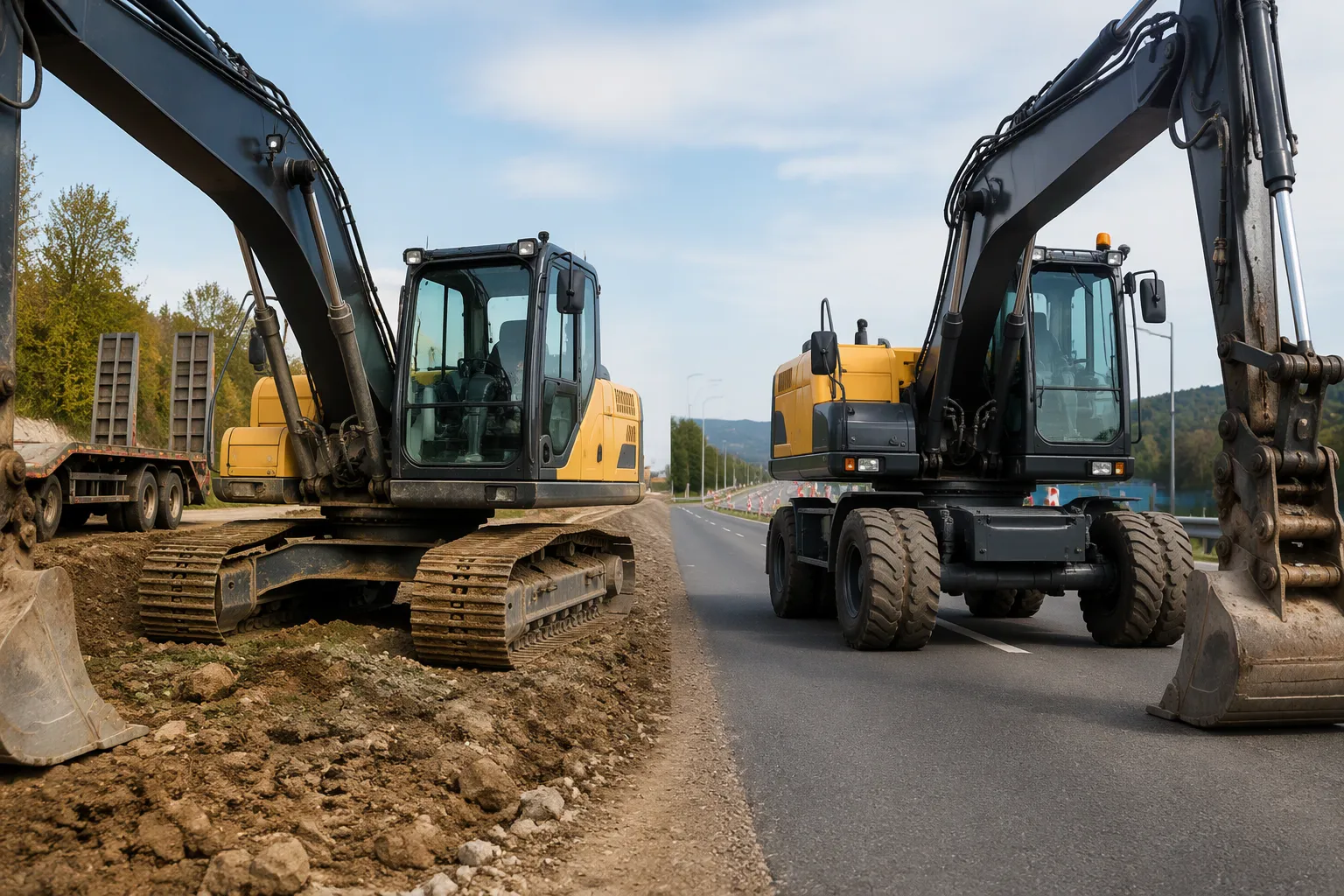
The table below condenses the practical differences covered in this crawler excavator vs. wheeled excavator guide. Each row shows where a machine type fits best. No row declares an overall winner, because the right answer depends on the job.
Dimension | Crawler Excavator | Wheeled Excavator |
|---|---|---|
Mobility | Travels at roughly 2–5 km/h; long moves require a flatbed trailer | Self-propels on public roads at 20–40 km/h; no trailer needed for short to medium transfers |
Terrain | Low ground pressure limits sinking in mud and sand; strong traction on slopes | Best on hard, paved, or compacted surfaces; slips in mud and loose gravel |
Stability | Low center of gravity and wide track footprint provide a stable base for heavy loads | Needs hydraulic stabilizers (outriggers) for heavy lifts or uneven ground |
Performance | Clear advantage in heavy-duty work on uneven ground | Similar digging performance in ideal conditions; highly flexible configurations |
Surface impact | Tracks can damage paved roads when driven directly on them | Rubber tires cause minimal damage to asphalt and concrete |
Price | Initial purchase price is generally competitive; track replacement is costly over time. | Slightly higher initial cost due to axles, but lower transport and maintenance costs in urban settings. |
Performance figures reinforce the pattern without settling it. Hyundai's HX305L crawler model lists a maximum digging depth of 22 feet 9 inches and a massive breakout force under SAE measurement, making it ideal for heavy earthmoving. Meanwhile, Hyundai's HW wheeled series offers comparable breakout forces for their weight class but with the added benefit of road mobility.
The practical reading is straightforward. A project that stays in one place on soft or uneven ground points toward tracks. A contract that hops between paved sites points toward tires. The next section turns these signals into a selection checklist.
Choosing Between a Crawler Excavator vs. Wheeled Excavator
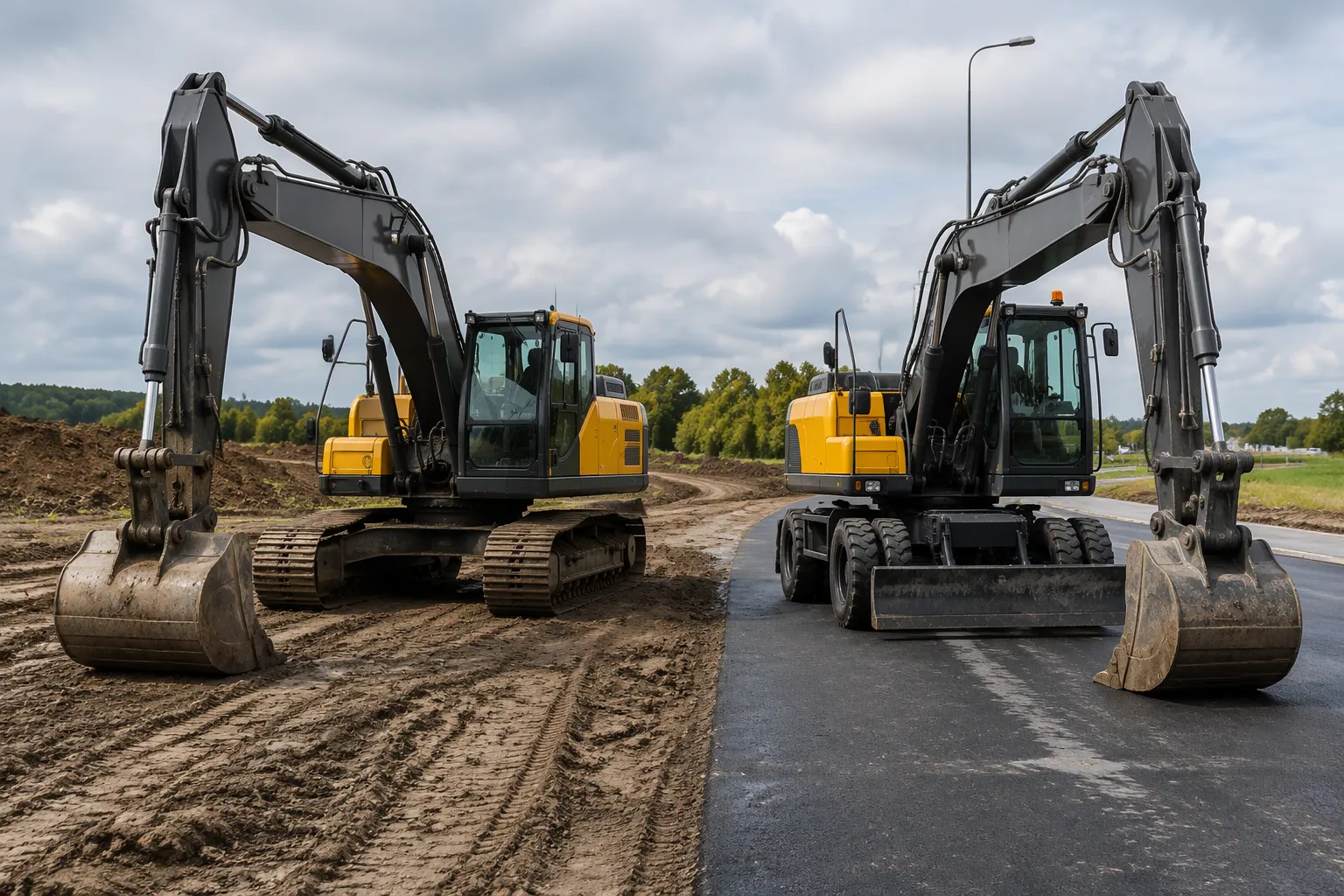
The final decision comes down to matching the machine to the work. A buyer who weighs terrain, project length, travel needs, scope, and budget will usually find one type fits better. The table below maps common site conditions to the machine that suits them.
Condition | Recommended Machine | Reason |
|---|---|---|
Rough, muddy, or soft ground | Crawler excavator | Wide tracks disperse weight and prevent sinking |
Asphalt, concrete, or compacted gravel | Wheeled excavator | Tires grip firm surfaces and protect pavement |
Urban sites with frequent relocation | Wheeled excavator | Fast, self-propelled travel between locations |
Long-term mining or heavy earthworks | Crawler excavator | Sustained traction under heavy loads on uneven ground |
Wet or frozen ground | Crawler excavator | Tracks keep grip where tires may lose traction |
Match the machine to the job. Terrain, project length, travel frequency, and budget should drive the choice, not habit.
Job Site Conditions and Project Duration
Ground conditions set the first filter. Crawlers are recommended for terrain that is difficult for groundwork, because a wide base avoids sinking in soft soil and ground marked by holes and furrows. Wheeled machines perform best on tarmac or solid ground, yet they grow unstable on sand, loose rough surfaces, and hillsides. Frost or snow buildup may impede wheeled development, so winter downtime belongs in the plan.
Project duration reinforces the pattern. Crawlers are recommended for mining operations and large-scale projects that run over relatively long periods. A machine that stays in one place for months can trade travel speed for traction and stability. Short municipal contracts with scattered locations favor the wheeled unit instead.
Mobility Needs, Scope, and Budget
Travel frequency shapes the second filter. The capacity to move between sites rapidly is a major benefit of wheel excavators. A smaller turning radius makes the machine safer in restricted locations or around obstacles, and four-wheel drive improves navigation of uneven or rocky terrain. A crawler can also be moved, yet it is not ideal for frequent road travel over long distances.
Scope of work narrows the choice further. Urban projects, municipal landscaping, utility installation, infrastructure repairs, roadway construction, and demolition are natural fits for wheeled machines. Crawlers suit extensive excavations in soft soil, heavy-duty lifting, foundation work in wet conditions, road building, and land clearing.
Budgeting for heavy equipment closes the loop. While a new wheeled excavator may have a slightly higher upfront cost, it eliminates daily flatbed transport fees and reduces surface repair liabilities. Crawlers may need more regular undercarriage maintenance in difficult terrain, so buyers should budget for those extra costs on demanding sites.
Sourcing is the last practical question. Tianhengweiye, a premier Hyundai construction equipment partner with more than 25 years of experience, offers both crawler and wheeled excavators, along with special-equipment modifications and comprehensive after-sales support.
The crawler excavator vs. wheeled excavator decision rests on a clear split. Tracked machines lead on stability, traction, and sustained heavy-duty output. Rubber-tired machines lead on speed, road travel, and work over paved surfaces.
Match the machine to the job. Terrain, project length, travel frequency, and budget should drive the choice, not habit. A final check belongs on total cost of ownership. Buyers should weigh fuel, maintenance, depreciation, and resale value alongside the invoice, since the purchase price is rarely the full financial picture.
FAQ
How fast can each machine travel?
A crawler excavator moves at roughly 3 to 6 km/h. A wheeled excavator reaches 25 to 40 km/h on paved roads. The wheeled unit therefore drives itself between nearby sites, while the tracked machine usually needs a trailer for any real distance.
Which machine exerts less pressure on the ground?
Tracks spread weight across a long contact patch. Crawler ground pressure typically falls between 0.3 and 0.6 kg/cm². Wheeled units concentrate weight on four tire points. Lower ground pressure keeps a crawler from sinking in mud, sand, and soft soil.
How long do wheeled excavator tires last?
Tires typically last 3,000 to 5,000 hours. Replacement costs run $400 to $1,200 per tire, depending on size and ply rating. Axle and steering service is usually required every 2,000 hours. Track assemblies generally outlast tires in harsh, abrasive ground.
Can a crawler excavator drive on asphalt?
Steel tracks can scar asphalt and concrete during turns. Crews then absorb milling, patching, and cleanup charges. Rubber tracks reduce the damage but still leave marks. A wheeled machine rolls on rubber tires with minimal surface impact, which suits paved contracts.
Ready to Optimize Your Fleet?
Whether your projects demand the heavy-duty traction of a Hyundai HX Crawler series or the urban agility of a Hyundai HW Wheeled series, Tianhengweiye has the right machine for your terrain and budget.