


Heavy Equipment Supply-Chain Checklist: A Preseason Stress Test
 Sep 14, 2026|
 View:9
From Port Backup to Bad Weather: Heavy Equipment Supply-Chain Checklist
From Port Backup to Bad Weather: A Preseason Supply-Chain Stress Test for Heavy Equipment
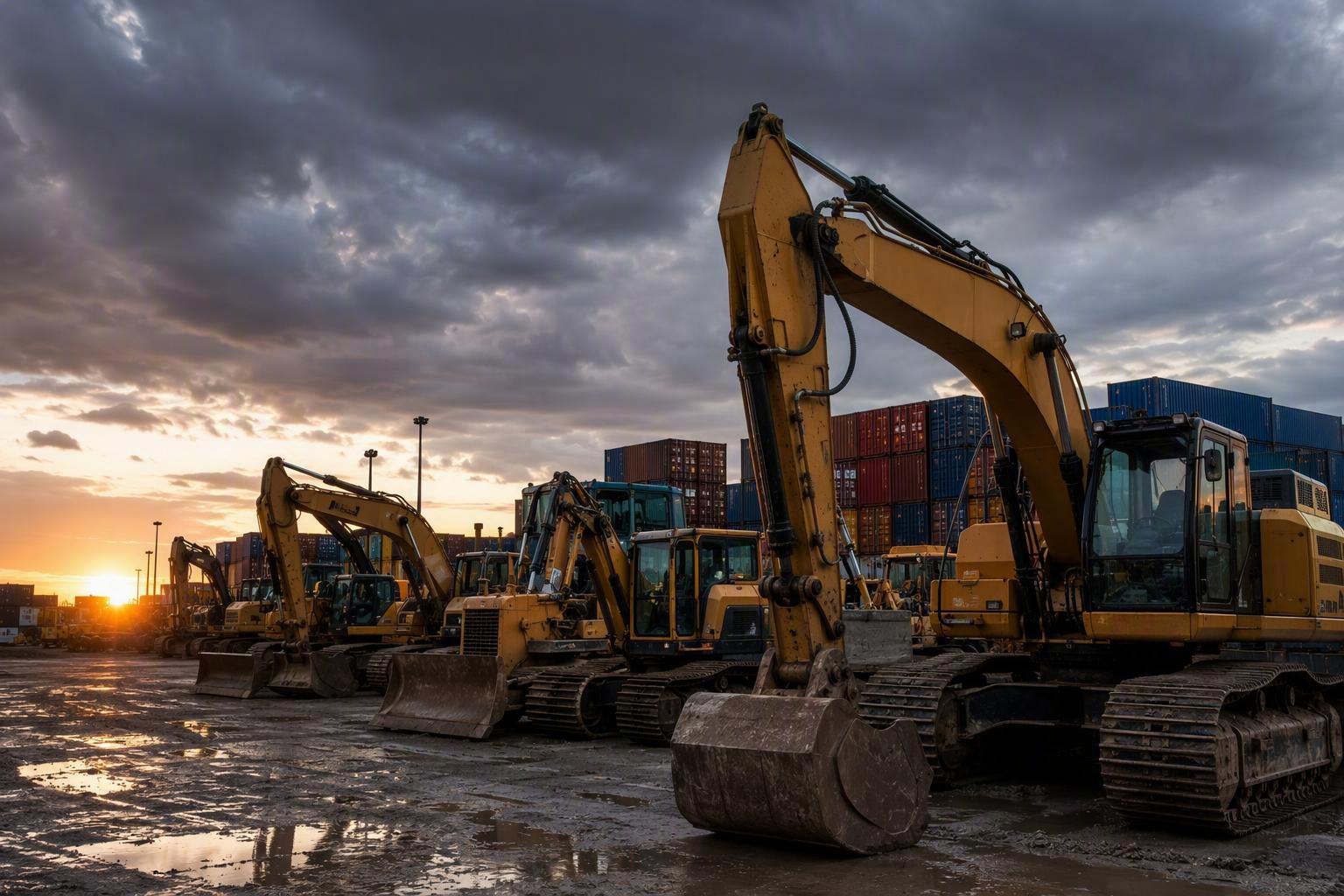
A one-week port strike doesn't cost you one week. According to a 2024 Equipment World report on the U.S. East and Gulf Coast labor action, construction solutions firm Gilbane estimated that a week-long work stoppage creates a backlog that takes four to six weeks to clear. Layer that against hurricane season, Red Sea rerouting, or a late-spring ground freeze, and your fleet's ability to stay productive depends almost entirely on decisions you made months earlier — before anything went wrong.
A supply-chain stress test is not a disaster plan. It is a structured preseason audit that forces a fleet to answer one question across five specific domains: If something disrupts our normal supply chain today, how long until we feel it on the jobsite — and what is our fallback? The checklist below adapts that framework to construction fleets operating heavy civil, specialty, and infrastructure equipment.
By the Tianheng Parts & Service Team — drawing on 25 years of Hyundai equipment support and a 50-branch parts and service network serving fleets across heavy civil, specialty, and infrastructure projects.
Five Domains of Construction Fleet Supply-Chain Readiness
A robust preseason review covers these five areas in sequence:
Domain | Core Question |
|---|---|
Machine criticality | Which machines create a schedule-breaking delay if they go down? |
Alternate suppliers | Who do we call when our primary supplier can't deliver? |
Parts staging | Do we physically have the parts we'd need within a lead-time disruption window? |
Service documentation | Can a different technician service this machine tomorrow? |
Communication alignment | Do our contractors, distributors, and operators share the same escalation path? |
Work through each domain before your peak season begins. Flag any item you cannot check off as a gap requiring a resolution date and an owner.
Know Which Machines Can't Go Down
Not every piece of iron on your fleet carries the same risk. A preseason criticality assessment ranks machines by project impact so you can allocate your preparedness resources accordingly.
Critical Machine Assessment Checklist
Every machine in the active fleet is assigned a criticality tier (A = schedule-breaking if down; B = delays one trade; C = has a reasonable substitute)
Tier-A machines are identified by project, not just by unit number — the same excavator may be Tier A on one site and Tier C on another
Replacement lead time is documented for each Tier-A machine, based on current dealer and rental market conditions — not last year's figures
Specialized configurations — such as amphibious excavators, pile drivers, or demolition rigs — are flagged separately because rental substitutes rarely exist for modified or purpose-built equipment
Each Tier-A machine has a named backup plan: rental availability, sister-site redeployment, or a documented subcontractor option
Criticality ratings are reviewed at the start of each new project phase, not just at the beginning of the season
Pro Tip: Purpose-built or factory-modified machines almost always deserve Tier-A status by default. There is no spot rental for a 45-ton amphibious rig configured for a specific river-bottom depth — know this before mobilization.
Build Your Backup Supplier Bench
A single-supplier model works fine until it doesn't. The 2024 Deloitte supply chain resilience report documented shipping delays of up to 20 days on Red Sea rerouting alone — a timeline that makes "we'll order it when we need it" an unreliable strategy for long-lead components.
Alternate Supplier Qualification Checklist
At least two qualified sources are identified for each category of critical parts: OEM parts, wear items, hydraulic components, and control electronics
Each alternate supplier has been contacted within the last 90 days to confirm current lead times, minimum order quantities, and payment terms — conditions change faster than annual vendor lists
Authorized dealers are distinguished from resellers in the supplier list. An authorized dealer carries OEM-backed technical support and a traceable genuine-parts supply chain; a reseller may not — so verify dealer status, not just price
Backup suppliers are vetted for geographic reach — a supplier who ships well to your primary region may not serve your remote sites efficiently
Rental equipment providers are included in the alternate supplier list, with confirmed availability windows for Tier-A machine categories
At least one supplier in the backup list has confirmed response capability within 24–72 hours for emergency hydraulic seals, filters, and control components
Stage Parts Before You Need Them
Parts staging is the most direct buffer against supply chain disruptions. An AEM mid-year survey of construction equipment manufacturers and suppliers found that while international shipping delays had eased somewhat, component and materials shortages continued to apply pressure — and electronics shortages in particular remained a recurring constraint.
The numbers behind that pressure are worth grounding before you set stock levels. A 2025 heavy-duty parts supply-chain guide reports that components once arriving in 5–10 business days now routinely take 8–16 weeks, with electronic control modules running 12–20+ weeks. Broader industry estimates put Tier-1 OEM parts at roughly 8–12 weeks in North America. Those ranges — not your historical replenishment cycle — are the baseline your minimum stock should be built against.
Parts Staging and Inventory Checklist
A minimum stock list has been built for each Tier-A machine, covering the components most likely to fail under high-usage conditions: undercarriage wear items, hydraulic hoses, filters, seals, and electronic control modules
Stock levels reflect realistic lead times from current suppliers — if a control module currently takes 8 weeks to source, on-hand inventory covers at least a 10-week disruption window
Parts are staged physically near the jobsite or in a branch location that can reach the site within 24 hours, not just "in the warehouse" three states away
Genuine OEM parts are clearly separated from aftermarket substitutes in inventory records; Tier-A machines must be maintained with OEM parts to protect warranty and performance guarantees
Inventory counts are reconciled at the start of each season and after every major repair event — parts consumed for emergency repairs are restocked within two weeks, not left as a gap
A reorder trigger is set for each high-consumption item, so procurement is notified automatically before stock falls below the disruption-window minimum
Warning: A "sufficient" parts inventory is not a number — it is a lead-time multiple. If your most critical parts take 8 weeks to ship, holding 2 weeks of stock is not sufficient. Build your minimums against disruption lead times, not normal replenishment cycles. As industry reporting on parts lead times shows, electronic control modules can run 12–20+ weeks while common wear items may arrive in days — the multiple shifts by part category, so treat each line item separately rather than applying one blanket rule.
Keep Your Service Records Combat-Ready
Service documentation is the operational backbone of fleet readiness. If your primary technician is unavailable, or if a machine needs to be serviced at a different location or by a different team, a complete and accessible service record is the difference between a one-day delay and a two-week diagnostic exercise.
Service Documentation Checklist
Every machine in the fleet has a current service record that includes: last service date, engine hours at service, work performed, open issues flagged but deferred, and next scheduled service milestone
Service records are accessible to both field supervisors and the distributor's service team, not stored only on one person's phone or laptop
Open work orders — repairs that were noted but not completed — are listed by machine with a written rationale for the deferral and a deadline for resolution
Machine-specific service manuals and wiring diagrams are either stored on-site or retrievable within four hours from the distributor
For modified or custom-configured machines, modification documentation is current and available to any technician who may need to service the unit — especially for amphibious configurations, long-reach modifications, or pile-driving setups
Warranty status is documented for each machine, including which components are still covered and what service requirements must be met to preserve coverage
Align Contractors, Distributors, and Operators Before Crisis Hits
Communication failures during a supply chain disruption frequently cost more time than the disruption itself. When a field operator reports a hydraulic failure at 6 AM, the response speed depends entirely on whether the right escalation path was established before that call happened.
Contractor–Distributor–Operator Communication Checklist
A single escalation contact at each distributor and parts supplier is named and confirmed for emergency parts requests — not a general 1-800 number, a named person with a direct line
Operators on each jobsite know the two-step escalation: who to call first (site supervisor), who gets notified next (fleet manager or procurement), and at what point the distributor is contacted directly
A standard format for emergency parts requests is agreed on with your distributor: machine model, serial number, failed component description, current location, and urgency tier — communicated upfront rather than sorted out under pressure
Contractors and subcontractors sharing equipment or jobsite resources have a clear agreement on who owns the service relationship for shared machines
A weather disruption protocol exists: if a named storm, port strike, or regional logistics event is declared, which parts orders are expedited, which deliveries get rerouted, and who authorizes the spend
At least one face-to-face or video preseason review has been conducted with your primary distributor's service manager to align on the season's project schedule, fleet profile, and anticipated high-demand periods
Key Takeaway: The weakest link in most communication chains is the gap between the field operator who notices a problem and the procurement team who can actually act on it. Close that gap with a defined escalation path before the season starts, not after the first machine goes down.
The 90-60-30-Day Stress-Test Countdown
Running all five domains at once is difficult to coordinate. A time-phased approach distributes the work and ensures that long-lead actions — like parts procurement or supplier qualification — happen early enough to matter. The table below summarizes what each phase should close out; use it as a quick reference and work the detail that follows.
Phase | Primary Focus | Must Be Done By End of Phase |
|---|---|---|
90 days out | Criticality + supplier audit | Tier-A list finalized; backup supplier gaps identified; long-lead decisions made |
60 days out | Procurement + booking | Long-lead parts ordered; backup lead times confirmed in writing; service capacity booked |
30 days out | Verification | Staged parts confirmed on-site; documentation complete; communication path aligned |
Ongoing | Maintenance of posture | Checklist updated after every disruption, repair, and supplier failure |
90 Days Before Peak Season
Conduct the machine criticality assessment. Audit every unit for service history, open work orders, and parts status. Identify gaps in your backup supplier bench. This is the phase for decisions that have 8-week lead times.
60 Days Before Peak Season
Place orders for long-lead components identified in the parts staging checklist. Confirm backup supplier lead times in writing. Book distributor service capacity for scheduled maintenance so you aren't competing for shop time during the season.
30 Days Before Peak Season
Verify that staged parts are physically in place. Confirm service documentation is complete and accessible. Conduct the communication alignment review with your distributor and field teams. Resolve all open work orders on Tier-A machines or formally defer them with documented justification.
Ongoing
Treat the stress-test checklist as a live document. Supplier conditions, machine status, and project scope all change during the season. A construction fleet supply-chain preparedness posture is not set once at the start of the year — it is updated after every disruption event, every major repair, and every supplier performance failure.
Run Your Preseason Readiness Review Before the Season Locks You In
The heaviest supply chain risk for construction fleets isn't a single dramatic event — it's the accumulation of small gaps that were visible in March and not closed until July, when machines are already down and the jobsite is waiting. A preseason stress test gives fleet managers, procurement officers, and operations teams a shared framework for finding those gaps while there's still time to act on them.
If your fleet runs Hyundai equipment or you're evaluating parts supply coverage ahead of your peak season, contact Tianheng's parts and service team to review your fleet's coverage across their 50-branch distribution network and $5M genuine parts inventory. The conversation is most useful 90 days before your busiest period — not during it.
Recent News
1.What to consider when buying a Hyundai 300 excavator for construction projects
2026-04-072.A Comprehensive Guide to Choosing the Right Wheel Excavator for Your Project
2026-05-213.How much does a crawler excavator cost in 2026
2025-12-124.Hyundai 60 Excavator: Key Features and Specifications You Need to Know
2025-06-245.How Much Does an Excavator Cost: A Complete 2025 Pricing Guide for Construction Professionals
2025-08-22


