


How to Choose the Right Excavator Size for Your Construction Project
 Nov 09, 2026|
 View:26
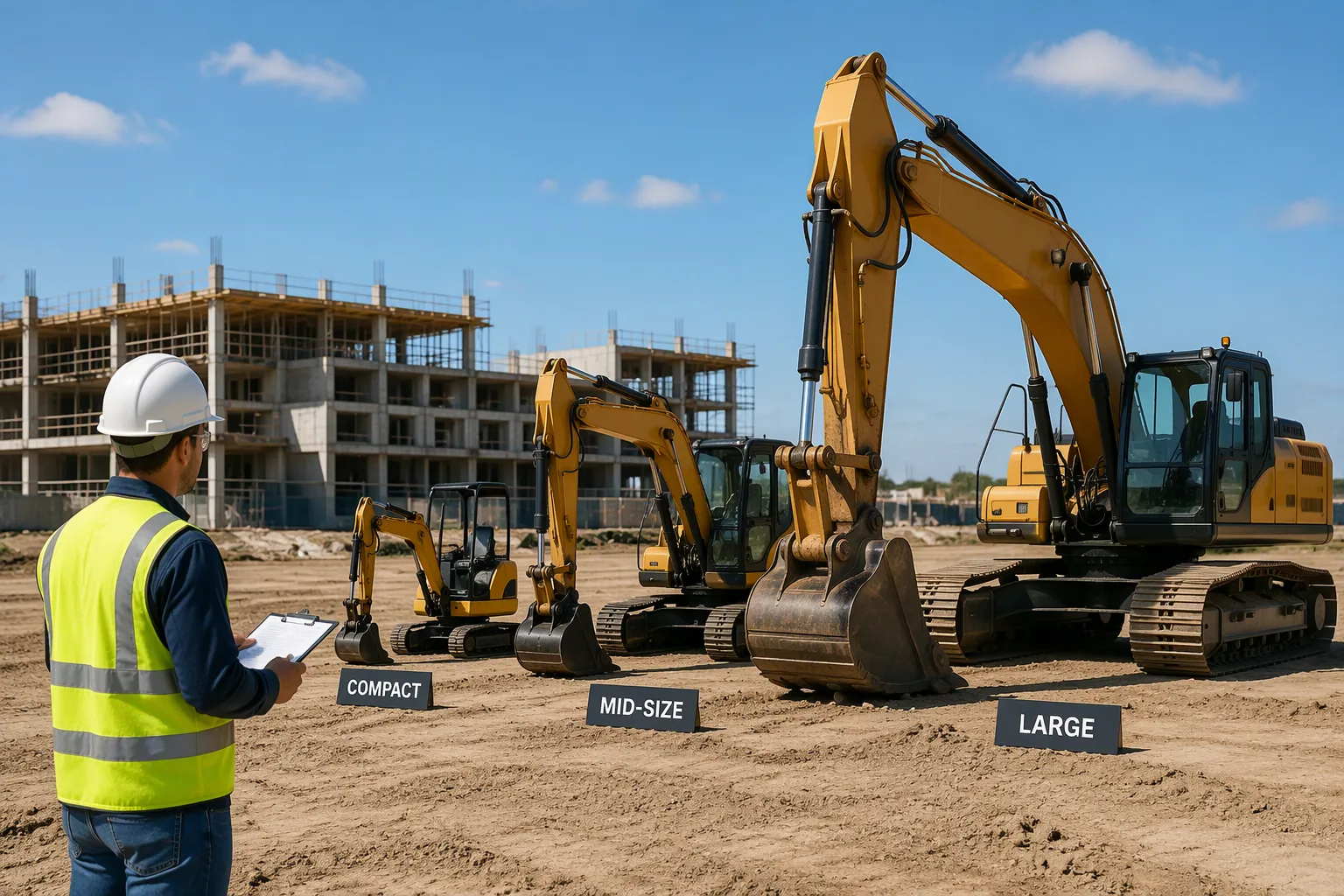
A 33-ton excavator and a 7-ton excavator will both dig a foundation. Only one of them will make money doing it.
Excavator size is a matching problem, and a mismatch shows up on the cost sheet long before it shows up on site. Oversizing adds purchase price, fuel burn, transport cost, and permit paperwork for capacity the job never uses. Undersizing shows up as waiting—on the bucket, on the breaker, on a larger machine that has to be mobilized mid-project.
Four variables drive the match: the work itself (depth, reach, and lift), the worksite (access, clearance, ground bearing), the attachments the job requires, and the budget that has to carry all of it. Each one can move the excavator size decision up or down a class.
This guide sets out the excavator size classes first, then the envelope numbers that separate them, then the site, attachment, and transport filters that eliminate candidates. It closes with a sizing worksheet and a production estimate you can take to a dealer.
Key Takeaways
Excavator size classes track operating weight: mini to about 6 t, midi 6–10 t, standard 10–45 t, large above 45 t. Catalogs disagree at the edges, so the label is a starting filter, not a decision.
Digging depth and reach, not tonnage, set what the machine can physically do. Two models one excavator size class apart can differ in the wrong direction: HX80 at 7.34 t lists 3,620 mm of digging depth against 3,730 mm on the lighter HX60PRO.
Rated lifting capacity is a separate rating from operating weight, read from a lift chart at one specific radius and height. A blank cell means zero capacity.
Site access and transport rules eliminate excavator size classes faster than performance does. In the US, 8 ft 6 in width and 80,000 lb gross vehicle weight are the usual permit-free ceilings.
Oversizing costs money every hour; undersizing costs money every cycle. Fix the duty cycle first, then confirm hydraulic flow and attachment weight against the carrier.
What the Excavator Size Classes Actually Mean
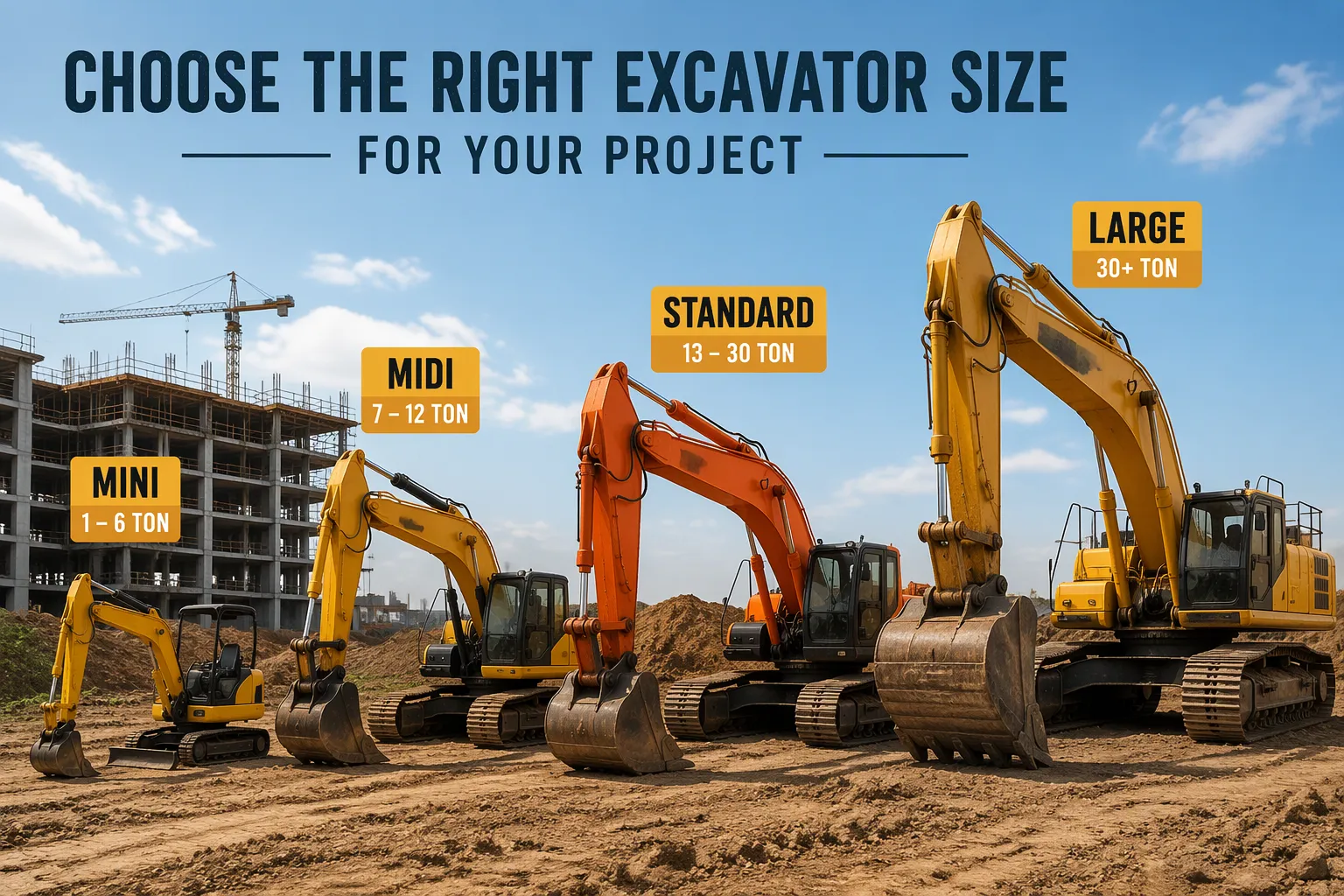
Excavator size classes are shorthand for operating weight, and operating weight is shorthand for how much machine the ground, the gate, and the truck will accept. Typical catalog divisions put mini machines at 6 t or less, midi units from 6 to 10 t, standard models from 10 to 45 t, and large machines above 45 t. Other dealers draw the mini line lower, starting compact units at about 1.5 t and running them to 6 t. The labels move between catalogs; the physics behind them does not.
What the class does not tell you is the working range. Two machines in the same band can carry different boom and arm combinations, different counterweights, and different tail-swing geometry, and those choices change depth, reach, and lifting capacity more than two tonnes of operating weight does. Use the excavator size class to shorten the list, then read the specification sheet.
Excavator Size Class | Operating Weight | Typical Work |
|---|---|---|
Mini | 6 t or less; some catalogs start compact units at 1.5 t | Landscaping, utility trenching, light demolition, farm work, indoor and rear-yard excavation |
Midi | 6–10 t | Deeper utility trenches, heavier demolition inside city limits, small foundations |
Standard | 10–45 t; most rental fleets sit at 19–24 t | Site preparation, foundations, commercial construction, general earthmoving |
Large | Above 45 t | Mass excavation, mining, quarrying, heavy demolition |
Mini and Midi Excavator Size Classes
Mini excavators suit tight spaces and small jobs, and the mini excavator size band runs from about 1 t to 6 t. Common work includes landscaping, utility trenching, light demolition, and agricultural tasks. Compact dimensions and maneuverability fit urban lots, residential properties, and back yards that a full-size machine cannot reach. Rubber tracks lower ground pressure and limit surface damage on paving and finished lawns, and fuel use and transport cost are both lower than in the next class up. Mini excavator size also decides how the machine reaches the site, since the smallest units travel on a standard trailer.
Midi excavators cover the same confined sites when the job needs more reach and power. A midi unit still fits through restricted access, but it carries a larger bucket and a longer boom than a mini. Contractors choose this excavator size class for deeper utility trenches, heavier demolition inside city limits, and small foundations where a mini would run out of depth before it ran out of room.
Standard and Large Excavators
Standard excavators are the most common excavator size class in commercial construction. They carry enough power and hauling capacity for demanding ground, and most models accept a wide range of work tools. This class covers large commercial projects, general site preparation, and foundation work. The 20-ton band around 19–24 t is where rental fleets concentrate, which keeps transport and parts support predictable.
Large excavators handle mass excavation. Bucket capacities reach 8 m³, and the work shifts to mining, quarrying, demolition, and heavy earthmoving. One builder's large range runs from 82,600 lb (37.5 t) to 207,400 lb (94 t), which is a fair illustration of how loosely the 45 t line is applied. The 50 t step is where haulage economics change, and a published review of a 50-ton class machine shows what shifts at that weight: boom geometry, bucket match, and transport planning. Above this point, excavator size is driven by haulage and cycle targets rather than by depth. The weight buys stability and breakout force, and it also brings transport planning: oversize permits, escort vehicles, and routes checked for bridge limits.
Where the Class Lines Blur
Three seams cause most of the confusion in excavator size classification. The first is the bottom of the range: a 1.5 t machine and a 6 t machine are both sold as mini, and they are not interchangeable. The second is the 10–19 t gap, where midi ends and the standard class has not really started; a 12.5 t machine behaves like a large midi on access and like a small standard on production. The third is the 45 t line, which some catalogs cross at 37.5 t.
The practical answer is to compare working ranges across the seam rather than inside an excavator size label. HX80 sits one class above HX60PRO at 7.34 t against 5.67 t, yet its maximum digging depth is 3,620 mm against 3,730 mm. The difference comes from working-device geometry and tail-swing design, not from weight. A buyer who shops by tonnage alone would read that pair backwards.
Need help matching an excavator size to your job?
Get a QuoteThree Numbers That Set the Working Envelope
Once the excavator size list is short, three numbers decide the rest: how deep the machine digs, how far it reaches, and how much it can lift at that reach. The first two come from the working-range diagram. The third comes from a separate lift chart that many buyers never open.
Digging Depth and Reach
Reach is the horizontal distance from the machine's swing centerline to the bucket teeth, and it governs how far the machine can dig and dump without repositioning. Digging depth is measured below grade. Both grow with excavator size, but not in a straight line: an under-2-ton unit typically lists about 1.7 m of maximum digging depth, while a 22-ton machine lists around 6.7 m. The chart below plots maximum digging depth across models grouped by excavator size class.
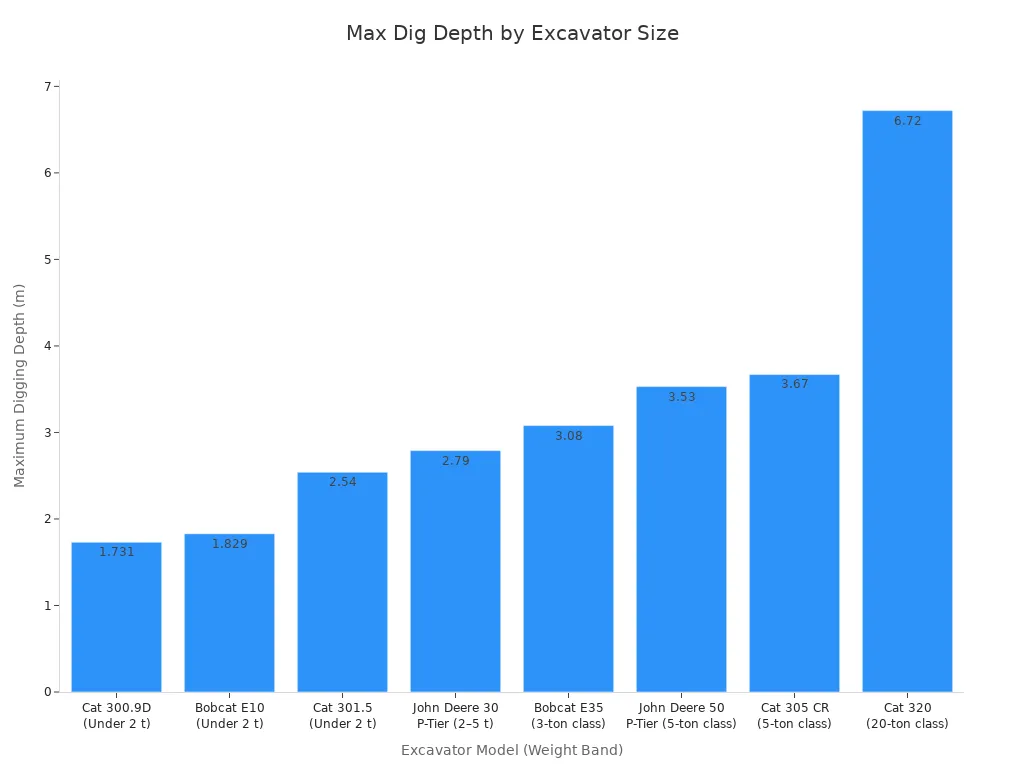
Maximum digging depth is not the depth available at every reach. It is one point on a curve, measured with the boom and arm in a specific configuration. Before committing, read the full working-range diagram: maximum reach at ground level, maximum depth at a vertical wall, and the radius at which the bucket still reaches the truck. A machine that meets the depth figure only at a radius the site cannot accommodate has not met the requirement.
The table below shows how excavator digging depth and reach move across one lineup, using published specifications. Read it across the rows rather than down the weight column.
Model | Operating Weight | Bucket Capacity | Max Digging Depth | Max Digging Reach | Max Digging Height |
|---|---|---|---|---|---|
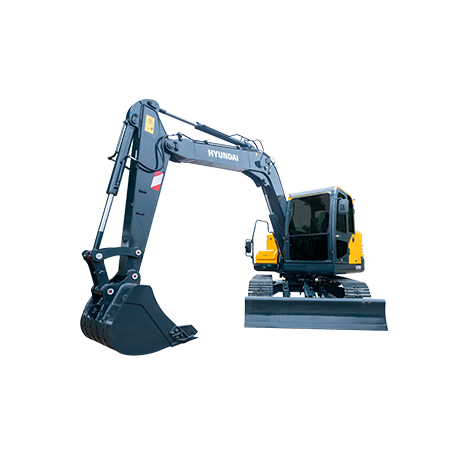
HX60PRO | 5.67 t | 0.21 m³ | 3,730 mm | 6,110 mm | 5,745 mm |
HX80 | 7.34 t | 0.32 m³ | 3,620 mm | 6,335 mm | 7,175 mm |
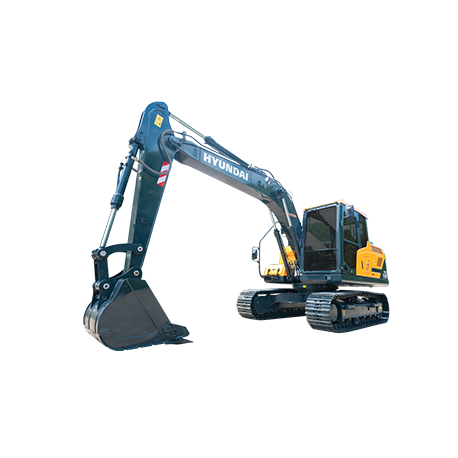
HX130 | 12.5 t | 0.52 m³ | 5,350 mm | 8,100 mm | 8,325 mm |
HW150 | 13.74 t | 0.58 m³ | 4,820 mm | 7,920 mm | 8,500 mm |
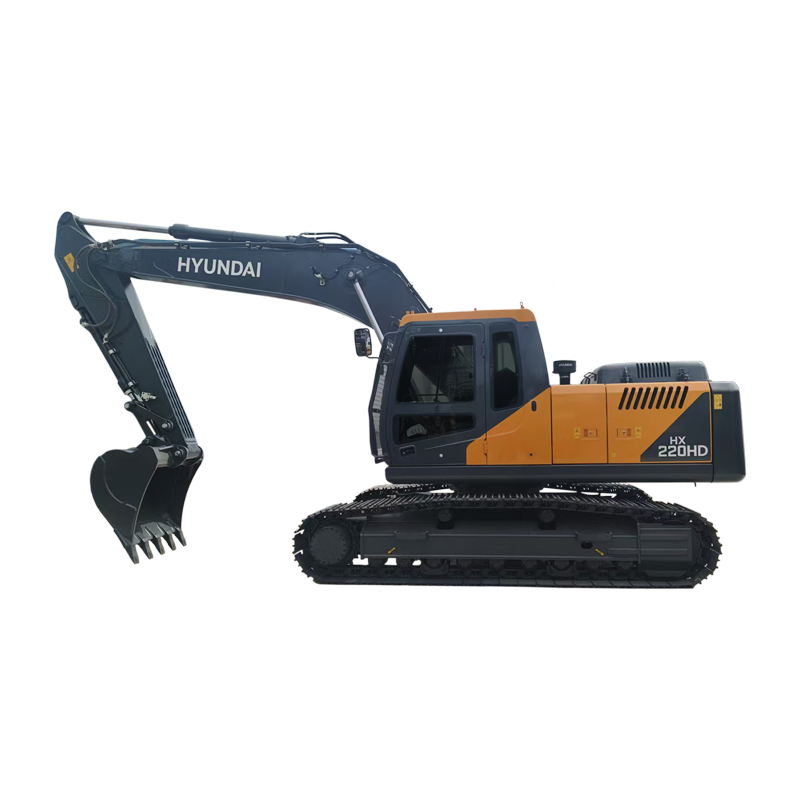
HX220HD | 21.42 t | 0.87–1.2 m³ | 6,730 mm | 9,980 mm | 9,600 mm |
HX340HD | 33 t | 1.44 m³ | 7,360 mm | 11,150 mm | 10,360 mm |
Two things stand out. Excavator digging depth does not increase with weight at the bottom of the range, where HX80 reaches 3,620 mm and HX60PRO reaches 3,730 mm. And the step from 12.5 t to 21.42 t buys 1,380 mm of depth and 1,880 mm of reach, while the step from 21.42 t to 33 t buys only 630 mm of depth. Production scales faster than envelope in the upper classes, which is why mass excavation pays for a large machine and trenching usually does not.
Lifting Capacity Is a Separate Rating
Operating weight is not rated excavator lifting capacity. A 21 t excavator does not lift 21 t, and the gap is wide: the same machine that digs to 6.7 m may be rated for a small fraction of its own weight at a working radius of 5 m over the side. Excavator lifting capacity comes from a lift chart, and the chart is specific to boom, arm, counterweight, bucket, track shoe, and blade position.
Hydraulic excavator lift ratings follow a stability limit and a hydraulic limit, and the published figure is the lower of the two at a stated radius and height. That is why the chart, not the brochure headline, is the document that matters. Reading it takes four steps:
Read the lift point height from the ground to the bucket pivot pin, not to the load.
Find the lifting radius from the swing centerline, and note whether the lift is over the front or over the side, and whether the blade is up or down.
Locate the cell where height and radius intersect; that value is the rated capacity.
Treat a blank cell as zero capacity and do not attempt the lift.
Capacity falls as radius grows, and over-side lifts are more restricted than over-front lifts. Ground slope, boom length, counterweight, and attachment weight all shift the rated figure, and a tool that is not in the chart is not covered by it. If the job involves setting pipe, precast sections, or steel, size the machine on the lift chart first and the bucket second. The lift requirement is usually the one that forces a change of excavator size class.
Site Conditions, Attachments, and Transport
Access, Clearance, and Ground Bearing
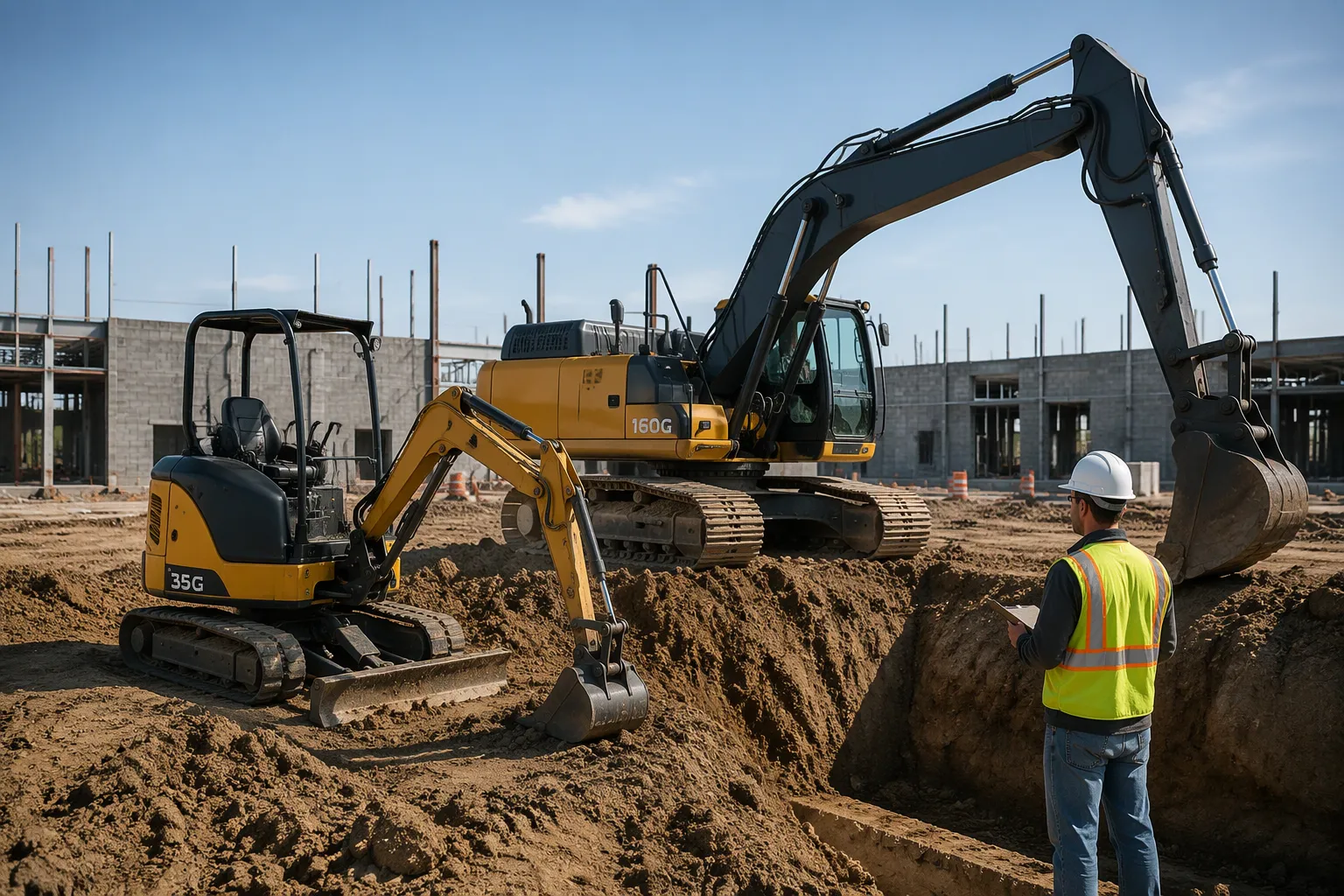
Site access filters the excavator size list faster than any performance number. Four measurements settle most of it: gate or ramp width, overhead clearance under power lines and bridges, ground bearing capacity, and the turning space available at the bottom of the ramp. A 3.0 m gate clears the 2,800 mm HX220HD with 200 mm to spare and stops the 3,280 mm HX340HD at the fence.
Tail swing matters wherever the machine works beside a wall, a traffic lane, or a trench edge. Tail-swing radius grows with excavator size: 1,655 mm on HX60PRO, 2,335 mm on HX130, 3,570 mm on HX340HD. A standard machine that fits through the gate may still not be able to slew without closing the lane. Zero and near-zero tail-swing designs solve that, at some cost in counterweight and lifting capacity.
Soft ground pushes the answer the other way. Low ground pressure needs wider shoes or a lighter machine, and a machine that sinks to the frame is not productive at any rated depth. Where the excavation is deep enough to need benching or shoring, safety requirements come before the sizing question: OSHA excavation requirements set slope, support, and access rules that the machine has to work within, and utility locating comes before the first bucket.
Attachments Change the Carrier
Attachments add weight and hydraulic demand, and both count against the carrier and can push the excavator size decision up a class. Dealer attachment charts commonly map buckets and small breakers to the 1–6 t band, breakers and trenchers to 7–20 t, and pulverizers and high-capacity breakers to machines above 20 t.
Attachment | Carrier Weight Band |
|---|---|
Buckets, small hydraulic breakers | 1–6 t |
Breakers, trenchers | 7–20 t |
Pulverizers, high-capacity breakers | Above 20 t |
Hydraulic flow is the second constraint. HX80 lists a main pump flow of 158.4 l/min; HX220HD lists two pumps at 234 l/min each. A high-flow breaker sized for the larger carrier will not perform on the smaller one, and a tool that demands more flow than the machine can supply will run slow, overheat, and wear early. Match flow and pressure to the tool, then check that attachment weight plus load stays inside the lift chart.
Specialized work needs more than a different bucket. Pile drivers, building demolition machines, and amphibious excavators are carrier conversions rather than attachments, and they change weight distribution, stability, and transport dimensions. They are specified with the purpose-built equipment range rather than added to a standard quote.
Transport and Permit Limits
Transport sets a hard ceiling on excavator size that no amount of site planning can move. In the US, the federal permit-free envelope is 80,000 lb gross vehicle weight, 8 ft 6 in width, 13 ft 6 in height, and 53 ft on a standard trailer. Above those figures the load needs an oversize permit, and widths beyond roughly 12 ft generally bring pilot or escort requirements, as summarized in federal truck size and weight limits.
Do the arithmetic before the demo. A 21.42 t excavator weighs about 47,200 lb on its own; add a lowboy and the combination sits close to the federal limit before any bucket or counterweight goes on the deck. A 33 t machine at roughly 72,750 lb exceeds the limit with the trailer alone. That difference shows up as permit fees, escort cost, restricted travel hours, and routes that avoid bridges with posted limits, and it falls hardest on short rentals and multi-site work.
Have a site plan? Get a configuration and a price.
Contact UsBudget and the Cost of Getting the Excavator Size Wrong
Purchase Price, Fuel, and Utilization
Purchase price rises with excavator size, fuel burn rises with excavator size, and both have to be earned back in machine hours. A higher price demands consistent usage: a machine that works 400 hours a year carries the same depreciation as one that works 2,000, but over five times the cost per hour.
Total cost breaks into four lines: ownership (depreciation or lease, interest, insurance), operation (fuel, operator, wear parts, maintenance), mobilization (transport, permits, crane assist), and downtime (parts lead time, service access). Excavator size moves all four. The cheapest machine to buy is rarely the cheapest to run, and the largest machine on the lot is rarely the one with the strongest return.
Fuel is the line buyers underestimate. Consumption scales with engine displacement and hydraulic demand, so a step up in excavator size costs more per hour even when the work per hour does not change. Attachments add to it: a breaker on a 30 t carrier burns more than the same breaker on a 20 t carrier, and the difference has to be covered by the extra production.
A Sizing Worksheet You Can Take to the Dealer
Write these down before the first dealer call. The list is short, and it turns a conversation about models into a conversation about requirements.
Required dig depth, and the depth at which the machine must still reach the truck or the spoil pile.
Required reach at ground level and at full depth.
Heaviest single lift, the radius at which it is made, and whether the lift is over the front or the side.
Access width, overhead clearance, and the narrowest point on the route.
Ground conditions: bearing capacity, slope, and water.
Attachment list with weights, flow, and pressure requirements.
Transport route, permit limits, and whether the machine moves between sites.
Planned machine hours per year and expected project duration.
For a first pass at production, use a cycle-based estimate rather than a brochure claim: hourly output in loose cubic meters equals bucket capacity times bucket fill factor times cycles per hour times job efficiency.
Take a 12.5 t machine with a 0.52 m³ bucket on a trench of moderate depth. A 30-second cycle gives 120 cycles per hour; a fill factor of 0.90 and a job efficiency of 0.75 give 0.52 × 0.90 × 120 × 0.75, or about 42 loose m³/h. Stretch the cycle to 40 seconds and the same machine produces about 31 m³/h. That sensitivity is why cycle time, not bucket size, is usually the number worth arguing about.
State the excavator size class you think you need, bring the worksheet to the dealer, and ask for the working-range diagram and the lift chart for the exact configuration quoted. A quote that names the model but not the boom, arm, and counterweight is not a quote yet. Buyers comparing ownership against rental can work through the same four cost lines on the excavator cost breakdown.
Excavator size selection stays a matching exercise from start to finish. Begin with the task itself: required depth, reach, and lift. Filter the class list by site access and transport limits. Confirm the final choice against budget and fuel cost.
A short pre-shop checklist saves a site visit. Write down the job's depth, reach, lift, and access limits before buying or renting, and bring that list to the dealer with the working-range diagram attached.
The payoff is measurable. A properly sized machine delivers faster cycles, lower operating cost, and a stronger return; oversizing and undersizing both erode margin. Used on every project, these steps are how to choose the right excavator size without paying for capacity the job never uses.

FAQ
How do I size an excavator for a specific job?
Start with the working envelope. List the required dig depth, reach, and lift weight, then compare those figures against the working-range diagram and the lift chart rather than the headline depth rating. Confirm that the class also fits site access and transport limits before pricing it.
Does renting or buying change the size class I should pick?
The excavator size logic stays the same. Rental favors occasional work, where a high purchase price is hard to justify. Buying rewards consistent usage across many projects. Match the machine to the task first, then let the ownership model follow.
Can attachments change which size class I need?
Yes. Attachments add weight and demand hydraulic flow, so a tool list can move the excavator size requirement up a class. Buckets and small breakers suit the 1–6 t band, while pulverizers and high-capacity breakers call for machines above 20 t. Confirm that the carrier's flow and pressure match the tool, and add attachment weight to the lift calculation.
When should I bring in a dealer for sizing advice?
Early, for deep foundations, confined urban sites, or specialized work. The configuration questions, which cover boom and arm length, counterweight, tail swing, and hydraulic provision for a tool, are settled before the order, and changing them later is expensive.
What is the difference between operating weight and lifting capacity?
Operating weight is the machine's own mass. Rated lifting capacity is the load it can lift at a stated radius and height, and it is usually a fraction of operating weight. Read it from the lift chart for the exact configuration, and never estimate it from the weight on the specification sheet.
Is a larger excavator always more productive?
No. Production depends on cycle time, bucket fill, and how much of the shift the machine spends working. A larger machine that needs a permit to move, cannot fit through the gate, or waits on trucks can produce less than a smaller one that stays busy.
For buyers who want the class recommendation checked against real machine data, Tianhengweiye, a Hyundai Construction Equipment partner since 1999, advises on excavator size selection, genuine parts, and purpose-built conversions such as pile drivers, demolition machines, and amphibious excavators, with support across 50 branch locations. Send the worksheet and the site constraints, and the team will return a configuration rather than a brochure.
Recent News
1.Crawler vs. Wheeled Excavator: Key Differences, Costs & Best Uses
2026-11-032.Standard vs. Customized Excavator: Which Is Right for Your Project?
2026-10-133.Is the Hyundai HX60G the right choice for your next project in 2026
2026-06-304.How the Hyundai HX300 compares to other excavators in its class
2026-03-30