


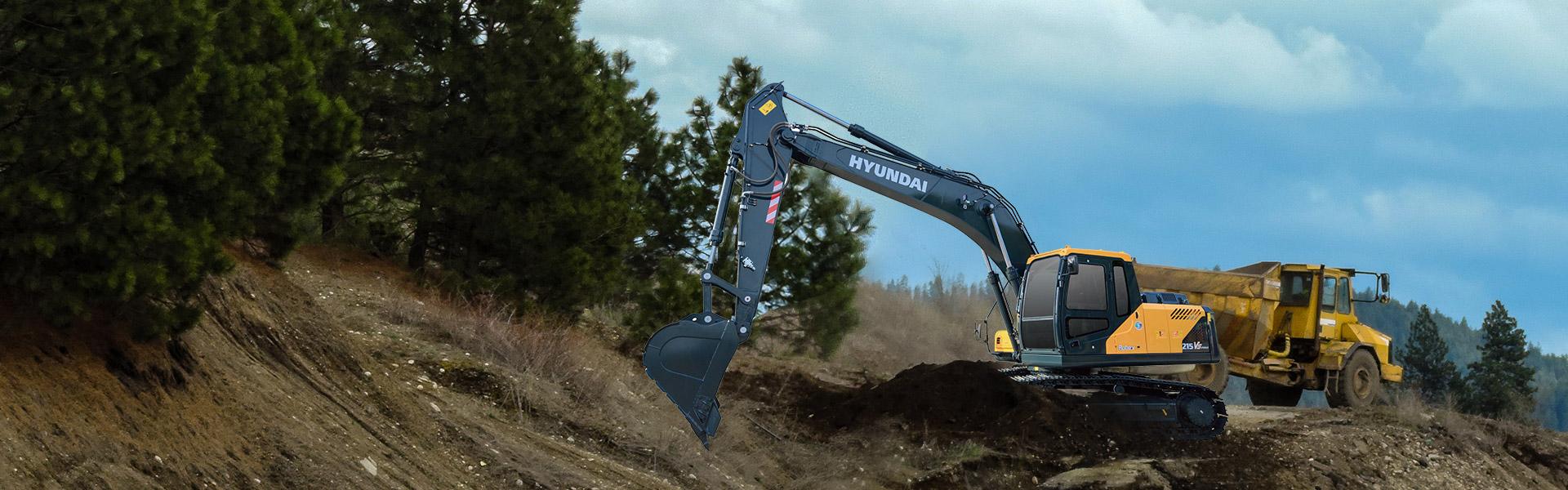
Hyundai HX375L 37.8 Ton Crawler Excavator: Specs and Duty Match
 Nov 12, 2026|
 View:26
Hyundai HX375L: A 37.8 Ton Crawler Excavator Built for Bulk Earthwork and Mine Stripping
Bulk earthwork is priced per cubic meter moved, so a 37.8 ton excavator earns its keep inside the cycle: how fast the bucket fills, how long the swing takes, whether the trucks keep up, and how many hours the machine runs before something stops it. The Hyundai HX375L is the largest HX series crawler unit supplied through Tianheng, with a 254 kW Cummins L9, a 1.9 m³ heavy-duty bucket on a 6.5 m boom, and 2 × 333 L/min of main pump flow. This review works through the power train, hydraulics, structure, undercarriage, cab and service points, states which figures come from the supplier rather than independent testing, and closes with the full specification table and the questions buyers ask most. The build sheet and downloadable catalog sit on the HX375L (T4) crawler excavator product page.
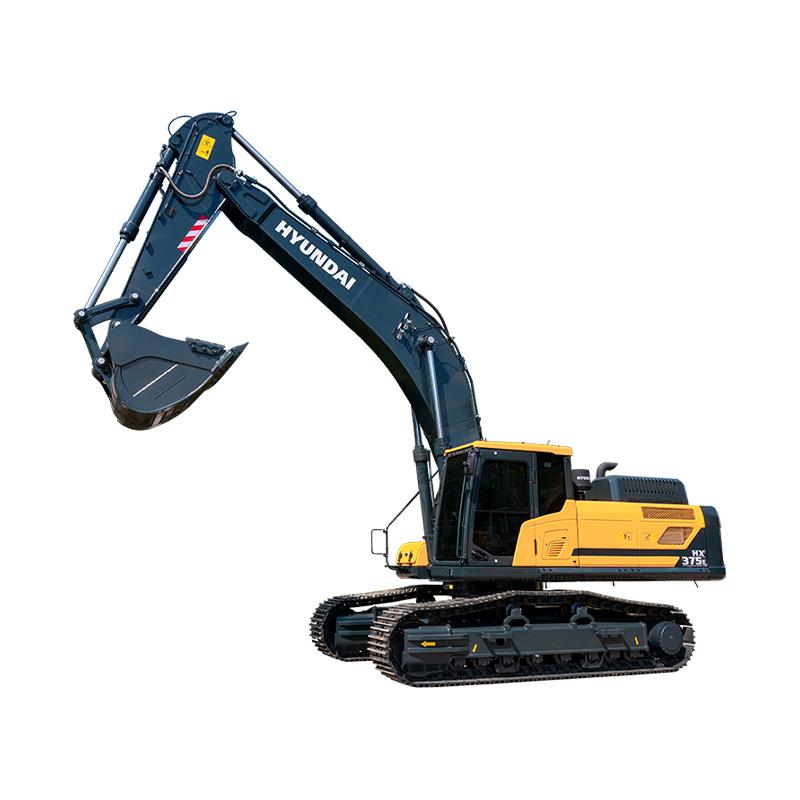
HX375L with the 6.5 m heavy-duty boom, 2.8 m arm and 1.9 m³ bucket.
Key Takeaways
The HX375L works at 37.8 ton operating weight with a 1.9 m³ heavy-duty bucket, sized for high-volume loading rather than utility digging.
Cummins L9 rated 254 kW at 1,900 rpm and 1,520 N·m at 1,100–1,400 rpm, with no EGR and a DOC + DPF + SCR package for Tier 4 control.
Imported electronically controlled main pumps at 2 × 333 L/min with EPIC independent pump control, and a 5–10% daily fuel reduction quoted by the supplier.
In-house HX375L rotation system tested over 10,000 field hours, with a 10% efficiency gain claimed for the current generation.
HX375L attachment: 6.5 m heavy-duty boom, 2.8 m standard arm and 1.9 m³ bucket, with upgraded bushings for wear and impact resistance.
The HX375L undercarriage runs 600 mm triple grouser shoes, double-sided carrier rollers and reinforced crawler guard plates for mixed earth and rock.
HX375L radiator arrangement changed to enlarge the heat-exchange area, with a temperature-driven hydraulic fan.
Cab with one-touch start, auto idle, one-touch emergency stop, Bluetooth and USB, plus an 8-inch color display with an optional rear camera.
Where the HX375L Sits in the 37.8 Ton Class
The 37.8 ton class, where the HX375L sits, is where an operation stops being a contractor with a machine and starts being a production line. Machines at this weight are bought for four duty types: bulk excavation and truck loading on earthwork contracts, stripping and face loading in open-pit mines and quarries, bulk transfer on municipal and highway projects, and short-haul loading in yards and stockpiles. What those duties share is volume per hour, and what decides volume is cycle time multiplied by bucket fill, not the number on the specification sheet.
The HX375L is dimensioned for that work. Maximum digging depth is 6,940 mm, maximum reach 10,950 mm, maximum digging height 10,750 mm and maximum dump height 7,620 mm, which puts a standard tipper body inside reach without repositioning on every pass. Tail swing radius is 3,620 mm and minimum swing radius 4,345 mm, the figure that decides whether the machine can work in a single-lane closure or against a face wall.
Truck match decides the real output
The HX375L 1.9 m³ bucket on a 37.8 ton carrier can out-load a small tipper fleet, and when it does, the extra capacity is wasted: the machine sits with a full bucket waiting for a body to arrive. Before comparing this class against a 30 ton unit, count the trucks, the haul distance and the target tonnage per shift. Where the fleet is already matched, the gain from a larger machine comes from fewer passes per truck and a shorter swing, not from a bigger bucket in isolation.
Ground conditions and shoe width
At 37.8 ton, what the machine stands on matters as much as what it lifts. The HX375L runs 600 mm triple grouser shoes on a reinforced crawler frame with double-sided carrier rollers. Wider shoes spread the load over more ground contact, which is what keeps a machine of this weight working on soft fill and graded surfaces instead of digging itself in; triple grouser pattern gives the bite needed to climb stockpiles and face ramps in dry, loose material.
Cummins L9: 254 kW Without EGR
The HX375L runs the Cummins L9, rated 254 kW at 1,900 rpm with 1,520 N·m of torque from 1,100 to 1,400 rpm. That torque band is wide and low, which is what a loading machine wants: the engine holds its pull through the dig instead of needing to be revved into a narrow window. The L series platform is also one of the more widely serviced industrial diesel families, and on a machine that runs two shifts a day, parts availability and technician familiarity are worth more than a few extra kilowatts.
The EGR decision
On the HX375L the exhaust gas recirculation circuit has been deleted. EGR lowers combustion temperature to control nitrogen oxides, but it routes exhaust back through the intake, which costs pumping efficiency and adds heat load to the cooling package. Removing it lets the engine be calibrated for cleaner combustion, and the nitrogen oxides work is handed entirely to the after-treatment system. The supplier's stated reason is straightforward: no EGR means no power loss from recirculation on a machine that spends its life at high load.
DOC, DPF and SCR in sequence
The HX375L after-treatment system is a DOC + DPF + SCR package: a diesel oxidation catalyst, a diesel particulate filter and selective catalytic reduction. In sequence, the DOC oxidizes unburned hydrocarbons and carbon monoxide, the DPF traps soot and burns it off during regeneration, and the SCR injects urea to convert remaining nitrogen oxides into nitrogen and water. This is the architecture most Tier 4 off-road engines use, and it is why the machine needs urea on site and not only diesel.
One clarification for buyers comparing documents: the HX375L export build is listed as T4 on our product page, while the domestic Chinese version of the same machine is sold under the China Stage IV standard. Both describe the same after-treatment approach, but the compliance package is confirmed per destination market at order stage rather than assumed from the model name.
Consumables are part of the cost model
An after-treatment system performs only if the inputs are correct. Three specifications matter: diesel with sulfur at or below 10 ppm, low-ash engine oil meeting API CK-4, and automotive urea meeting the GB 29518 standard where that specification applies. Ash from the wrong oil cannot be burned out of a DPF; it accumulates until the filter has to be cleaned or replaced, and sulfur shortens catalyst life. Saving on consumables usually returns as downtime, which on a 37.8 ton machine is charged per hour. Background on why diesel after-treatment and fuel sulfur limits matter is published by the US environmental regulator for transport emissions.
ECO Guidance turns fuel into a number
ECO Guidance on the HX375L watches the working state and prompts the operator when the machine is running outside an efficient range, and the display reports average and daily consumption. The point is not the prompt itself but what a fleet can do with it: when two operators on the same face produce different daily burn figures, there is finally a number to train against instead of an opinion about technique.
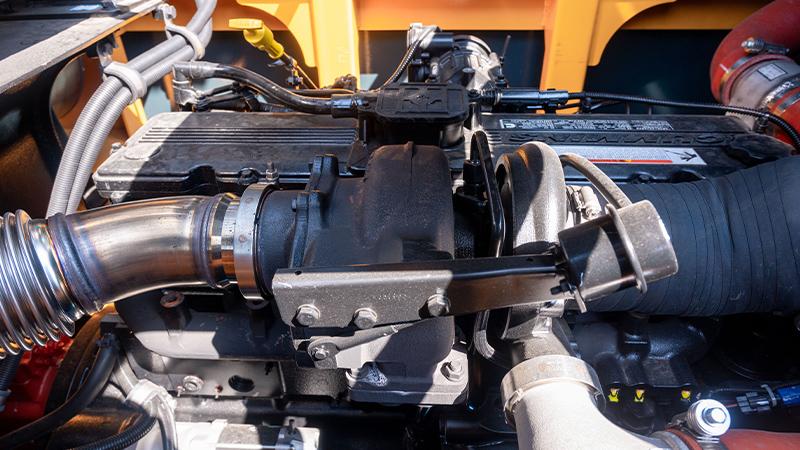
Cummins L9, 254 kW at 1,900 rpm, with the EGR circuit deleted and DOC + DPF + SCR downstream.
Need current pricing, container loading details or a specification sheet for the Hyundai HX375L?
Request a QuoteHydraulics: 2 × 333 L/min and EPIC Control
The HX375L uses imported electronically controlled main pumps with a rated flow of 2 × 333 L/min into an implement circuit at 350 kgf/cm². On a loading machine, flow is what keeps the bucket moving through the material without stalling, and EPIC electronic pump control manages the two pumps independently so flow is allocated by function rather than fixed by a single regulator setting.
Where the 5–10% comes from
On the HX375L, boom lowering and leveling are the two functions where independent control shows up first. Both are low-load, high-precision movements, and both are where an excavator burns fuel it does not need to burn if the pump is still delivering flow sized for a digging pass. Matching flow to the function, together with a revised spool and valve body that reduce pressure loss, is what the supplier credits with a 5–10% daily fuel reduction. The figure is duty dependent, which is why the machine also logs consumption rather than only quoting a percentage.
Rotation system: 10,000 hours of field data
The swing or rotation system on the HX375L is an in-house design, field tested over 10,000 hours, with a 10% efficiency gain claimed for the current generation. Swing is the function that repeats most on a loading job: a machine cycling a truck does more rotations per shift than digging strokes, so a small gain per swing compounds quickly. Swing speed is listed at 9.83 rpm.
What the operator actually feels
Flow allocation and pressure-loss reduction do not read as numbers in the cab. They read as a machine that holds engine speed when the bucket loads up, that does not sag and recover on every pass, and that lets an experienced operator keep a rhythm instead of working around the hydraulic response. That rhythm is where the last few percent of production on a loading job usually hides.
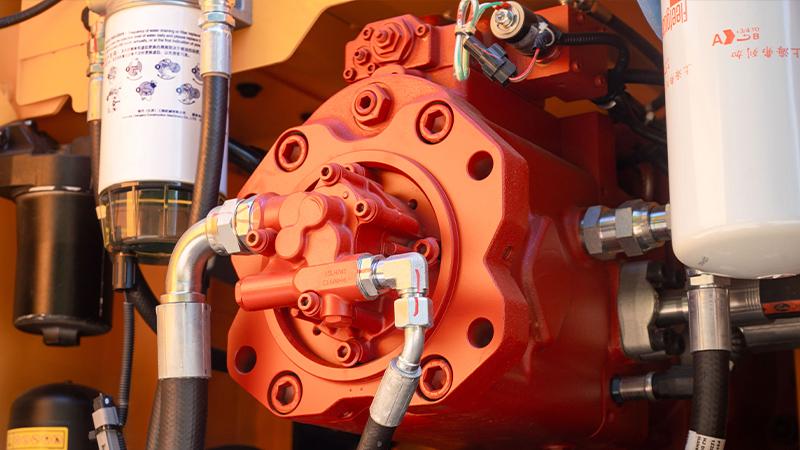
Imported electronically controlled main pumps, 2 × 333 L/min rated flow.
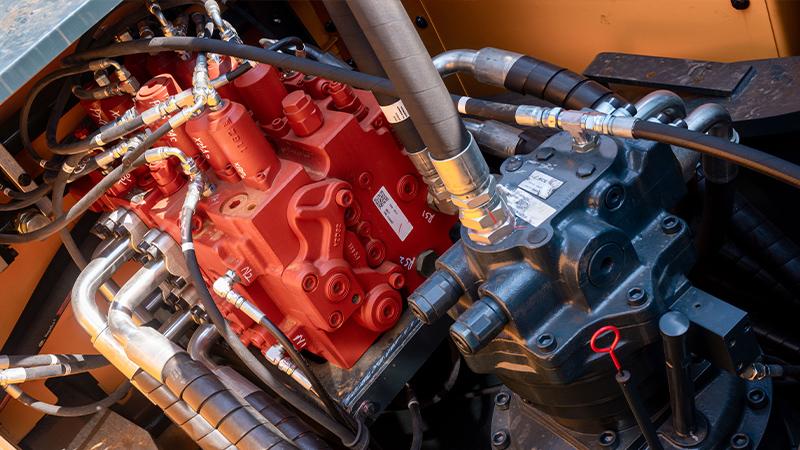
Revised valve and spool geometry reduces pressure loss through the implement circuit.
Structure, Undercarriage and Cooling
The HX375L working attachment is a 6.5 m heavy-duty boom with a 2.8 m standard arm and a 1.9 m³ heavy-duty bucket. The three are matched as a set rather than specified separately, which matters on a loading machine: an oversized bucket on a short arm slows the cycle, and an undersized one leaves the hydraulic capacity unused. Bushings in the attachment have been upgraded for wear and impact resistance, and on a machine working rock the practical benefit is measured in pin life and re-greasing intervals.
Undercarriage for mixed ground
The crawler frame runs 600 mm triple grouser shoes, double-sided carrier rollers and reinforced guard plates. Carrier rollers support the track between the idler and the sprocket; doubling them on both sides spreads the load and reduces the whip and wear that show up first on machines doing a lot of travel on uneven ground. Guard plates protect the links when the machine works over broken rock, which is exactly where a 37.8 ton unit operating in a quarry spends its hours.
Cooling: more contact area, demand-driven fan
The radiator arrangement has been changed to enlarge the heat-exchange contact area, and the hydraulic fan runs at a speed set by temperature rather than at a fixed ratio. In practice that combination does two things: it holds working temperature through a long shift in high ambient conditions, and it stops the fan from absorbing power it does not need when the machine is cool. On a mine or quarry face in summer, cooling capacity is what separates a machine that finishes the shift from one that has to be backed off.
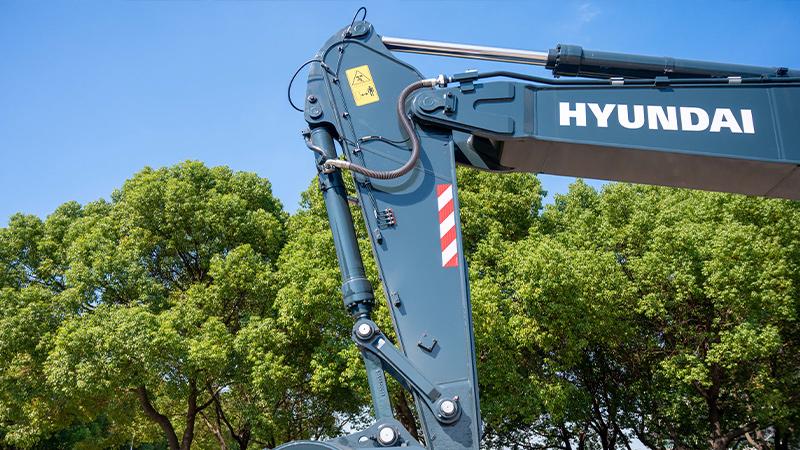
6.5 m heavy-duty boom with a 2.8 m standard arm and upgraded bushings.
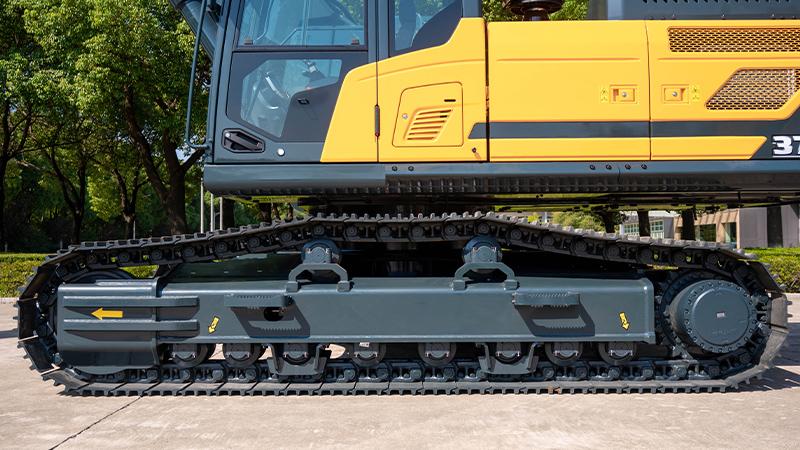
600 mm triple grouser shoes, double-sided carrier rollers and reinforced guard plates.
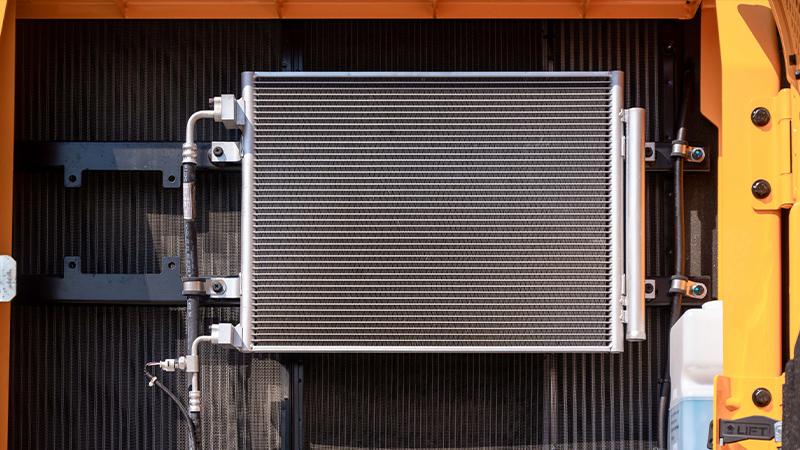
Enlarged radiator contact area with a temperature-driven hydraulic fan.
Cab and Controls
On a machine that runs a full shift, the cab is a production component. The HX375L uses the current HX series high-visibility cab with improved sealing, a suspension seat, wider air-conditioning outlets and lower operating noise, all of which push fatigue later into the shift. One-touch start, auto idle, a one-touch emergency stop, Bluetooth and USB are fitted as standard rather than as options.
The HX375L 8-inch color display groups fuel consumption, work mode, fault alarms, oil and coolant temperature, service reminders and, where specified, a rear-view camera feed. Having those readings on one screen changes how a shift is run: an operator can see a temperature trend or a fuel figure without leaving the controls, and a supervisor can read the same data at the end of the day instead of relying on memory.
Safety and Service Access
Two safety devices on the HX375L are worth naming. A pilot-pressure lock isolates the working functions when the operator is not seated, which covers the case of a lever being knocked while someone climbs in or out. A one-touch emergency stop sits below the seat so it can be reached from ground level without entering the cab. Neither replaces site procedure, but both remove a specific failure mode. Operator duties on excavation sites are described in the trenching and excavation safety guidance published by the US labor safety authority.
Service access on the HX375L is organized around grouped filters. On a 37.8 ton machine, a service point that takes twenty minutes instead of an hour is not a convenience: it is the difference between a check being done at the start of a shift and being deferred until the weekend, and deferred checks are where avoidable failures begin.
HX375L Specifications
The Hyundai HX375L specifications below are as stated on the product page and by the manufacturer. They are configuration dependent and should be confirmed against the build sheet for a specific unit and destination market.
| Item | HX375L |
|---|---|
| Machine class | 37.8 ton class crawler excavator |
| Operating weight | 37.8 ton |
| Bucket capacity | 1.9 m³ heavy-duty |
| Engine model | Cummins L9 |
| Emission | T4 on export build, DOC + DPF + SCR, no EGR |
| Rated power | 254 kW / 341 hp / 346 ps at 1,900 rpm |
| Maximum torque | 1,520 N·m at 1,100–1,400 rpm |
| Main pump rated flow | 2 × 333 L/min, EPIC electronic control |
| Implement circuit | 350 kgf/cm² |
| Swing speed | 9.83 rpm |
| Travel speed | 5.12 km/h high, 3.21 km/h low |
| Maximum gradeability | 35 degrees |
| Maximum traction force | 35.3 ton |
| Bucket digging force | 23 ton (ISO) |
| Arm digging force | 19 ton (ISO) |
| Fuel tank | 585 L |
| Hydraulic tank | 210 L (414 L system) |
| Overall length / width / height | 11,415 / 3,190 / 3,915 mm |
| Tail swing radius | 3,620 mm |
| Ground clearance | 530 mm |
| Boom / arm length | 6,500 mm heavy-duty / 2,800 mm standard |
| Maximum digging reach | 10,950 mm |
| Maximum digging depth | 6,940 mm |
| Maximum digging height | 10,750 mm |
| Maximum dumping height | 7,620 mm |
| Minimum swing radius | 4,345 mm |
| Track shoe | 600 mm triple grouser |
| Display | 8-inch color display with ECO Guidance |
Applications and Configuration Notes
The HX375L suits bulk excavation and truck loading on earthwork contracts, stripping and face loading in mines and quarries, bulk transfer on municipal and highway work, and short-haul loading in yards and stockpiles. The 6.5 m boom and 2.8 m arm keep a tipper body inside reach without constant repositioning, and the 2 × 333 L/min hydraulic capacity supports breaker and other attachment work where the circuit is specified for it.
Two decisions are worth settling before a purchase order: the compliance package for the destination market, and the attachment list for the actual material. A machine configured for loose aggregate in a river port and one configured for limestone face loading are not the same specification, even when the model name on the order is identical. If the undercarriage choice is still open, the comparison between tracked and wheeled machines is worth reading before committing to a transport plan.
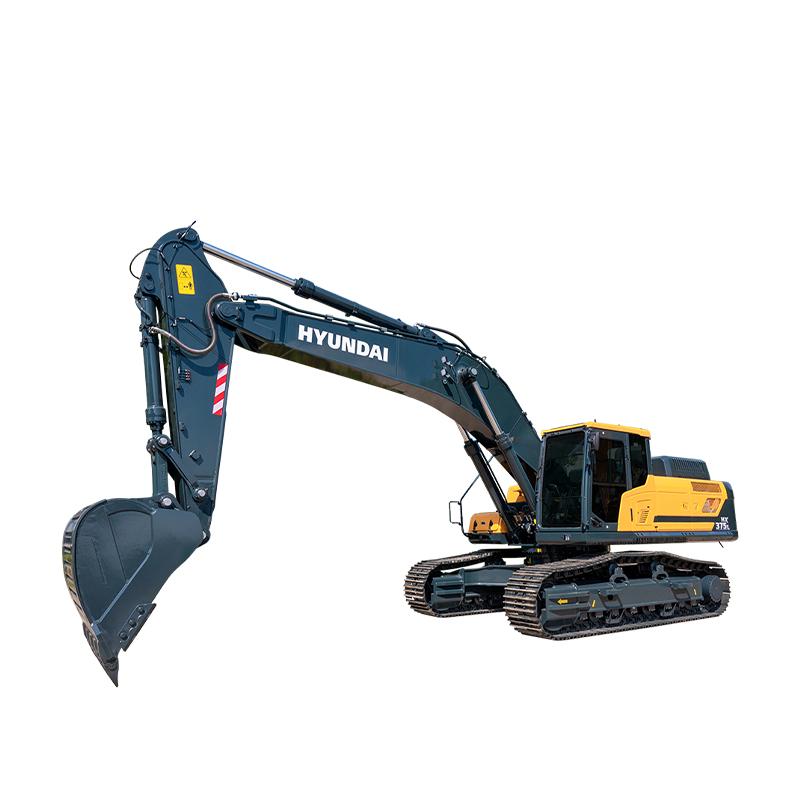
HX375L: 37.8 ton operating weight, 1.9 m³ heavy-duty bucket, 600 mm shoes.
Conclusion and Next Steps
A 37.8 ton crawler excavator such as the HX375L is a cost center before it is a production unit. The purchase price is written once; fuel, downtime and cycle time are written every shift for the life of the machine. The HX375L addresses each of those in a way that is consistent rather than piecemeal: dropping EGR hands emissions work to a DOC + DPF + SCR package and removes a recirculation penalty, independent pump control with a revised valve body reduces wasted flow, the rotation system is supported by 10,000 hours of field data, and the undercarriage and cooling package are specified for continuous work in rock and heat.
Choosing the Hyundai HX375L is about matching a proven 37.8 ton platform to your haul fleet and your material, so the machine earns on cycles per hour rather than on a specification sheet. Browse the wider excavator range or the crawler excavator category for comparable models, read the excavator pricing guide before you budget, and check what tracked versus wheeled undercarriages mean for your site access.
Ready to price an HX375L for your market?
Send your target configuration, truck body size and destination port. Our team replies with the specification sheet, quotation validity and expected delivery time.
Get Your HX375L QuoteFAQ
What emission standard does the HX375L meet?
The export build is listed as T4, with a DOC + DPF + SCR after-treatment package and no EGR. The same machine sold in China is marketed under China Stage IV. Export configurations can differ, so confirm the compliance package for your destination country with our sales team before ordering.
Which consumables does the after-treatment require?
Diesel with sulfur at or below 10 ppm, low-ash engine oil meeting API CK-4, and automotive urea meeting the GB 29518 standard where that specification applies. Using cheaper oil or off-spec urea is the most common cause of DPF and SCR faults, and the cost usually returns as downtime rather than as a saving.
Is the 1.9 m³ bucket standard, and can it be changed?
The 1.9 m³ heavy-duty bucket is the standard configuration on the export build and is matched to the 6.5 m boom and 2.8 m arm. Bucket and attachment options for specific material are confirmed at order stage, since the correct size depends on material density and on how the machine is loaded rather than on the model alone.
What does EPIC pump control change for the operator?
It lets the two main pumps be controlled independently, so flow is allocated by function instead of fixed by one regulator setting. On the HX375L that shows up in boom lowering and leveling, where flow is matched to a low-load precision movement, and in steadier engine speed when the bucket loads up mid-pass.
What is the 10,000 hour figure based on?
It refers to the supplier's field testing of the HX375L in-house rotation system, which is reported to have completed 10,000 hours with a 10% efficiency gain for the current generation. It is a supplier-stated durability figure rather than an independent test, and it should be read alongside the warranty terms and the service schedule for your market.
How do I judge whether this class fits my operation?
Start from the truck fleet and the target tonnage per shift, not from the bucket size. If the haul side cannot absorb a 1.9 m³ bucket, the extra capacity sits idle; if the material is dense rock, cycle time matters more than volume. Comparing the HX375L against a 31 ton machine on your own haul cycle is the fastest way to settle the question.
Contact Tianheng
Jiangsu Tianhengweiye Construction Machine Co., Ltd supplies Hyundai excavators and genuine parts for export markets, backed by a large genuine parts inventory and a network of direct-operated branches. For product data, spare parts and after-sales support, use the details below.
Address: No. 267, Hehai West Road, Changzhou, Jiangsu, China
Tel / WhatsApp: 0086-18951208765
Email: hyundai@th-mach.com or sale@th-mach.com
Product page: Hyundai HX375L (T4) Crawler Excavator
Website: www.th-mach.com
Recent News
1.Hyundai HX305L 31 Ton Crawler Excavator Specs and Duty Match
2026-11-062.Hyundai HX380VL: China Stage IV Large Excavator
2026-10-283.Standard vs. Customized Excavator: Which Is Right for Your Project?
2026-10-134.Hyundai HX130: Urea-Free China Stage IV Excavator
2026-09-305.Hyundai HX305VL: China Stage IV Mining Excavator
2026-10-15