


Mini Excavator vs. 20-Ton Excavator: Which Offers Better Value?
 Oct 20, 2026|
 View:43
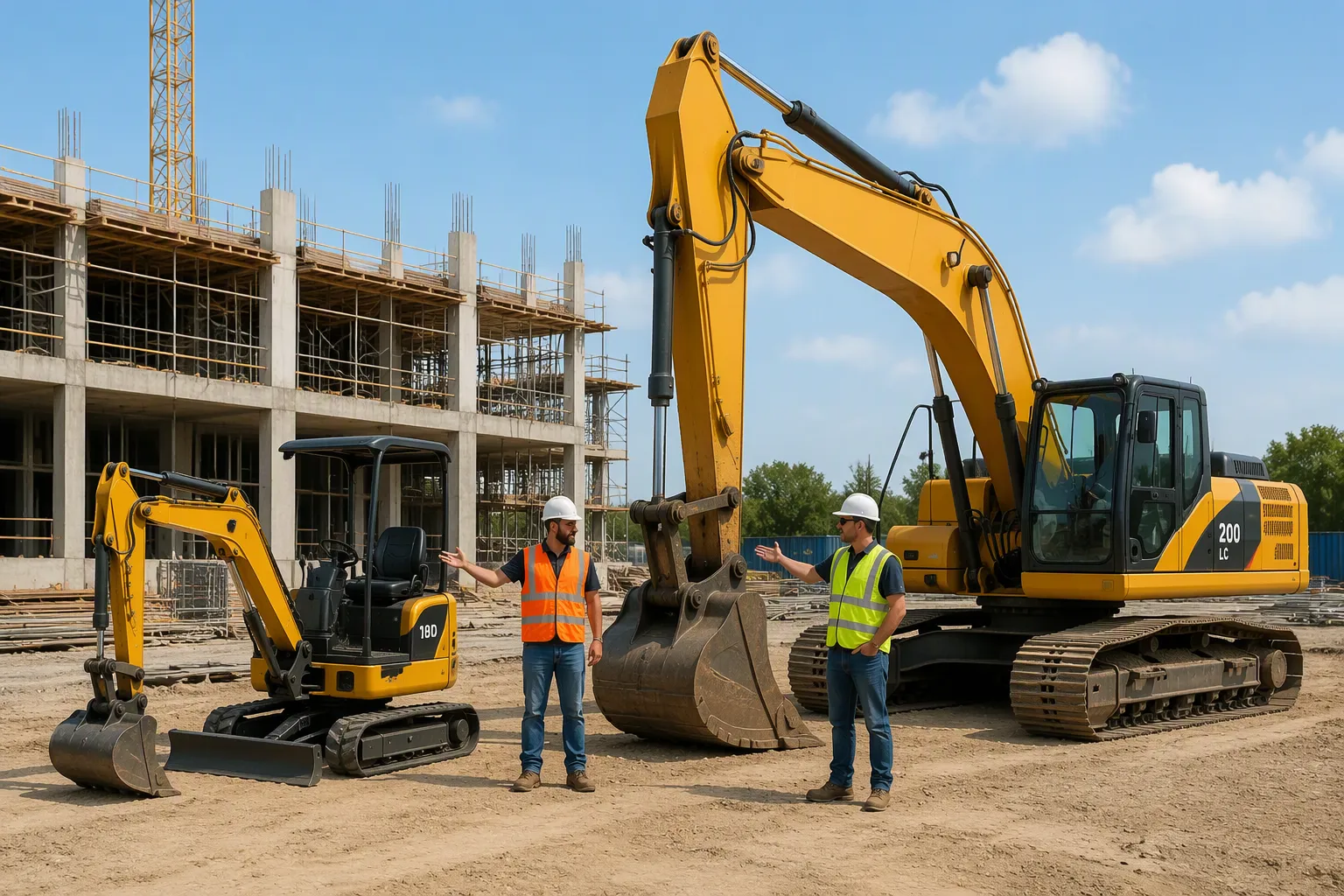
The machine that delivers better value depends on the job, not the machine alone. Mini excavators carry lower upfront and operating cost for small-scale, confined projects. A 20-ton excavator brings higher productivity and durability. That premium pays off when high volume justifies the higher price. Fuel use shows the gap clearly: a mini burns roughly 1.5–3.5 gal/hr, a large excavator 4–7 gal/hr. But for global buyers, container shipping efficiency often decides the true value. So which offers better value? Match the machine class to your project. Project scale, site access, logistics, and expected utilization decide the answer.
Key Takeaways
Choose the machine that fits your job, not the biggest or smallest one.
Pick the smallest machine that can finish the work efficiently to save money.
Mini excavators cost less to buy, fuel, and maintain than 20-ton excavators.
20-ton excavators dig deeper and move more material per hour for big jobs.
Mini excavators fit through narrow gates and work in tight spaces.
Container shipping: 3-4 mini excavators fit in one 40HQ container; 20-ton units require Ro-Ro vessels.
Rent a machine for occasional work; buy when you have steady projects.
A supplier with both machine types and good parts support helps you choose.
The Short Answer
Value Is Job-Dependent
No single machine wins on every site. Project scale, site access, and utilization define value. A machine that sits idle burns money. A machine that cannot reach the work zone wastes labor. A machine that is too small for the workload stretches the schedule. Each of these failures costs more than the sticker price difference between classes.
The evidence points in two directions. A 20-ton machine offers greater digging depth, reach, and lifting capacity. Those traits suit heavy-duty excavation, demolition, and large-scale landscaping. A mini excavator offers compact size and maneuverability for confined spaces, plus lower fuel consumption. Its limits are reduced depth and reach. Project scale favors the 20-ton machine for power and productivity. Site access constraints favor the mini. Buyers who ask which offers better value? must answer a prior question first: what does this job actually demand?
The Smallest Efficient Machine
The most economical choice is the smallest machine that completes the job efficiently. This rule keeps cost low without sacrificing output. A mini excavator fits through a personnel door at roughly 39 inches with retracted tracks. It works indoors, in crowded urban sites, and around obstacles. A 20-ton machine measures about 8 feet wide and cannot follow it there.
The same logic runs in reverse on open ground. A mini reaches a maximum dig depth of 11–15 feet. A 20-ton machine digs up to 22 feet and lifts to 23 feet. A large excavator clears that workload in fewer cycles. Forcing a mini into bulk earthmoving raises cycle counts and stretches the schedule. The table below frames the trade-off.
Metric | Mini excavator (3–8 ton class) | 20-ton excavator (18–22 ton class) |
|---|---|---|
Max dig depth | 11–15 ft | up to 22 ft |
Max dump/lift height | 12–16 ft | up to 23 ft |
Operating width | ~52 in standard; ~39 in with retracted tracks | ~8 ft wide |
Reach capability | max ~15–16 ft | greater reach and weight capacity |
Container Loading | 3-4 units per 40HQ | 1 unit per 40FT Flat Rack / Ro-Ro |
Transportation belongs in the same calculation. For global buyers, a mini moves efficiently in standard shipping containers, while a 20-ton unit requires specialized Ro-Ro vessels or breakbulk shipping. That hauling cost counts against the larger machine on international orders. Match the class to the site, the workload, and the logistics. The detailed comparisons below show how each factor shifts the answer.
Mini vs. 20-Ton: Which Offers Better Value?
Defining the Two Classes
Mini Excavator Basics
A mini excavator generally does not exceed 8 tons in weight. The market range spans from about 0.8 tons up to 8 tons. Machines in this weight range equipped with a dozer blade are typically classified as mini excavators. The 3- to 5-metric-ton class is a contractor favorite. It balances capability with easy transport.
Buyers can sort mini excavators into three groups by operating weight. Micro units sit under 2 tons and dig 6–8 ft. Utility units run 3–5 tons and dig 8–12 ft. Compact units run 6–8 tons and dig 12–16 ft. A 3.5-ton utility-class machine typically produces 5,000–7,000 lbf of bucket breakout force. Published breakout force figures represent the geometric maximum.
20-Ton Excavator Basics
A 20-ton excavator belongs to the medium-to-large class. It offers greater dig depth, breakout force, and lifting capacity than any mini. These traits suit bulk earthmoving, demolition, and high-volume production. Models in the 18–22 ton range may include a dozer blade for added stability and grading. That blade helps on leveling work and on sloped ground.
Key Specs at a Glance
The table below summarizes the mini classes. The 20-ton column stays qualitative, because published figures vary by manufacturer and configuration.
Class | Operating Weight | Typical Dig Depth |
|---|---|---|
Micro | Under 2 tons (under 4,400 lbs) | 6–8 ft |
Utility | 3–5 tons (6,600–11,000 lbs) | 8–12 ft |
Compact | 6–8 tons (13,200–17,600 lbs) | 12–16 ft |
20-ton class | 18-22 tons (39,600-48,400 lbs) | Greater depth and reach than any mini |
How to Use This Comparison
Start with project scale and site access. These two factors narrow the field fast. A confined residential lot points toward a mini. A bulk cut on open ground points toward a large excavator. Only after that screen should you compare costs and performance.
The next step is to weigh ownership cost against output. Mini and standard excavators differ in fuel use, shipping needs, and purchase price. A 18-22 ton class machine costs more to buy and run. It earns that back through faster cycles on volume work. Readers who ask which offers better value? should treat the answer as a match between machine and job. The sections below break down cost, performance, and transport for both classes.
Cost Comparison: Upfront and Operating
Purchase Price Ranges
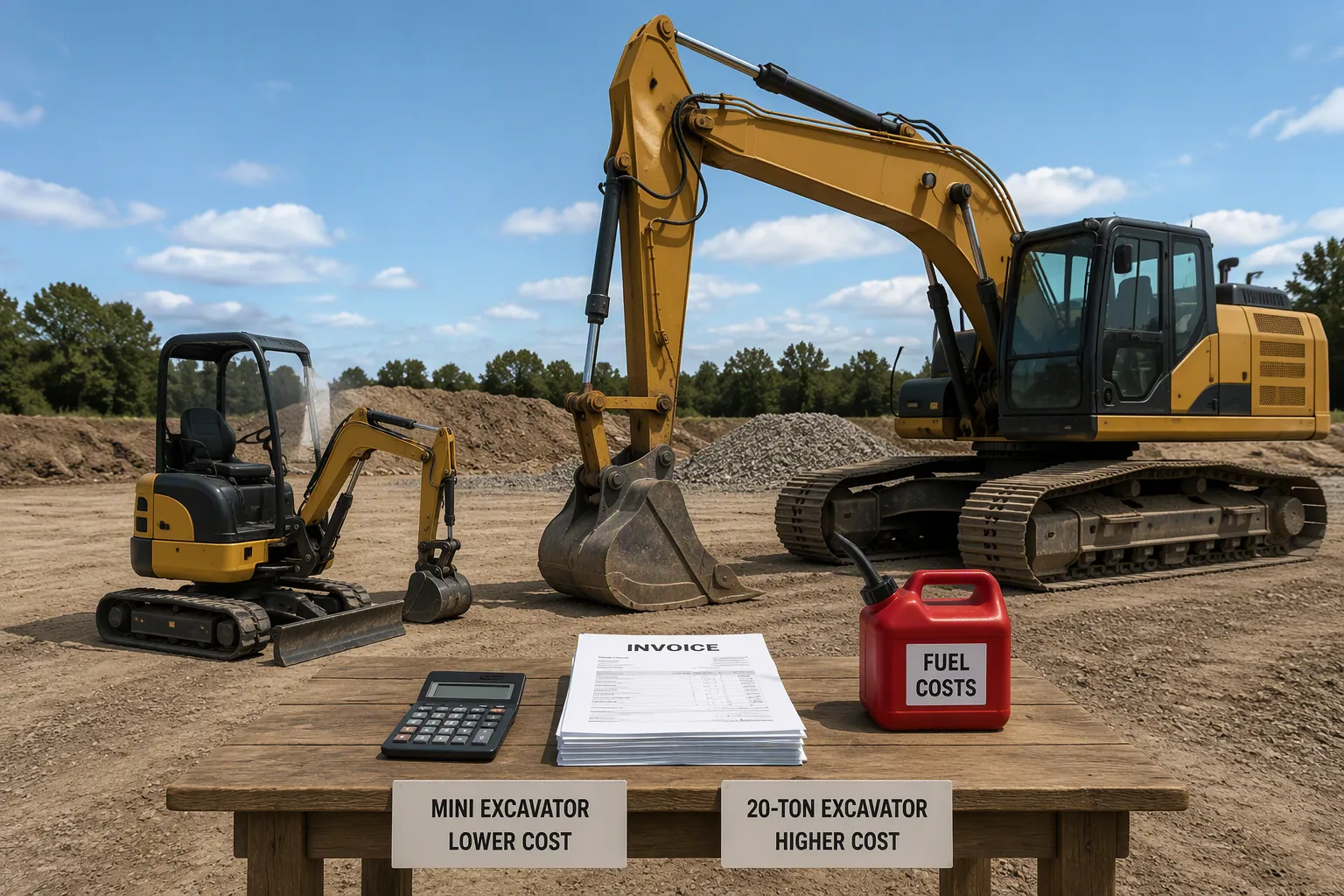
Sticker price is only the first line of a cost comparison. Total cost of ownership adds fuel, maintenance, shipping, and labor to the purchase figure. Each line behaves differently across machine classes. Buyers who weigh only the invoice miss the bigger picture.
New mini excavators span a wide price band by size class. The table below draws on market data. Their ranges differ, so treat each row as a planning band rather than a fixed quote.
Size class | FOB Price range (USD) |
|---|---|
1–2 tons | $18,000 – $35,000 |
3–4 tons (landscaping/residential) | $25,000 – $45,000 |
5–6 tons | $40,000 – $65,000 |
6–8 tons (commercial) | $55,000 – $85,000 |
20-ton class | $120,000 – $180,000+ |
A new 5.5-ton excavator costs significantly more upfront than a 3.5-ton model. Premium brands price 10–15% higher than budget brands. The most productive sweet spot for many buyers sits at $30,000–$50,000. The 20-ton class carries a substantially higher sticker price than any mini, but offers superior productivity on volume work.
Fuel and Maintenance Costs
Fuel separates the classes sharply. A mini burns roughly 1.5–3.5 gal/hr. A large excavator burns 4–7 gal/hr. Over a full season, that gap compounds. Maintenance follows the same pattern. A 20-ton machine carries more hydraulic fluid, larger filters, heavier undercarriage parts, and higher replacement costs per service interval. A mini needs less of everything.
Transport belongs in the same ledger. A mini moves efficiently in standard shipping containers (3-4 units per 40HQ). A 20-ton unit requires Ro-Ro vessels or flat-rack containers, with significantly higher per-unit shipping costs. Those charges land on every international order. Labor adds another line. A large excavator often needs a dedicated operator plus support equipment. A mini can work with a single operator in tight quarters.
The operating cost profile favors mini excavators on small sites. A large excavator earns its higher operating costs back through faster cycles on volume work. Neither pattern is universal. Utilization decides which one holds.
The Container Shipping Advantage
For global buyers and distributors, logistics efficiency often decides the better value. This is where mini excavators dominate:
Mini excavators (3-5 ton): 4 units fit in one 40HQ container. FOB shipping cost per unit: $3,000-$5,000 to most global ports.
Mini excavators (6-8 ton): 2-3 units per 40HQ container. FOB shipping cost per unit: $5,000-$8,000.
20-ton excavator: Requires Ro-Ro vessel or 40FT flat rack. Shipping cost per unit: $12,000-$25,000+ depending on destination. Longer lead times and port restrictions apply.
This logistics gap means a dealer importing 4 mini excavators pays roughly the same total shipping cost as importing one 20-ton unit. For distributors building inventory across multiple market segments, the mini class offers superior capital efficiency and faster turnaround.
Performance Comparison
Dig Depth and Reach
Dig depth sets the limit on what a machine can reach without repositioning. A mini excavator reaches a maximum dig depth of 11–15 feet. A 20-ton machine digs up to 22 feet. That gap matters on deep utility trenches, basement excavations, and any cut below the reach of a compact unit. A mini forced past its depth limit needs ramps, stepped benches, or a second repositioning pass. Each workaround adds time to the schedule.
Reach follows the same pattern. Mini dump and lift height runs 12–16 feet. A large excavator lifts to 23 feet. Greater reach lets the bigger machine load high-sided trucks and place spoil farther from the cut. On a tight residential lot, that extra reach becomes a liability. The machine cannot swing without striking a fence, a wall, or an overhead line. Depth and reach favor the 20-ton class on open ground. Confined sites reward the shorter, more compact geometry of a mini.
Breakout Force and Lifting
Breakout force decides how well a machine cuts hard material. A 3.5-ton utility-class mini typically produces 5,000–7,000 lbf of bucket breakout force. Published figures represent the geometric maximum. A 20-ton machine carries substantially more breakout force and lifting capacity. That reserve pays off in compacted soil, rock, and demolition debris. The larger machine also lifts heavier pipe, precast sections, and spoil with greater stability.
Lifting capacity ties directly to operating weight. A heavier machine resists tipping under a load at reach. A mini works close to its tipping limit on many lifts. The operator must check the load chart before every pick. This constraint does not make the mini weak. It simply defines the load range where the machine stays safe and productive. Match the lift to the class, and both machines perform within their design envelope.
Cycle Times and Productivity
Cycle time depends more on job conditions than on the machine. Short-swing tipper loading runs fast. Deep trenching or 180° swings to a stockpile add seconds per pass. Those seconds multiply across roughly 180 cycles per hour. Measure the cycle properly before drawing conclusions:
Stand where the full cycle is visible.
Start timing when the bucket enters the material; stop when it returns to the same ready-to-dig position.
Time ten consecutive cycles and divide by ten.
Repeat in the afternoon, since cycle times lengthen as the day progresses.
Skilled operators hold cycle-time variance within 5–10%. That consistency separates a well-run site from a chaotic one. The table below shows the output gap between classes.
Equipment Class | Weight Range | Bucket Capacity | Productivity Rate |
|---|---|---|---|
Mini Excavators | 1–8 tons | 0.5–0.7 CY | 15–30 CY/hr |
Medium Excavators (incl. 20-ton) | 18–22 tons | 1.3–2.0 CY | 60–120 CY/hr |
The numbers tell a clear story. A 20-ton excavator moves several times the material of a mini in the same hour. That output advantage drives better productivity and efficiency on volume work. Daily production on a bulk cut reflects the larger bucket and the shorter cycle count. A mini still wins where access limits the site. Its daily production stays modest, yet the job gets done where no standard excavators could enter. Choose the class that matches the workload, and the power and performance of either machine will show in the results.
Transport and Maneuverability
Local Towing and Hauling
On local job sites, hauling separates the two classes more sharply than any spec sheet line. A mini moves on a standard trailer behind a light truck. A 20-ton unit needs a heavier rig, and often permits or partial disassembly. Those charges land on every job change, so transportation costs weigh against the larger machine on short projects.
The table below shows the towing bands for the mini range.
Size Class | Weight (lbs) | Towing Requirement |
|---|---|---|
Micro (1–2 ton) | 2,000–4,000 lbs | Towable with most half-ton pickups |
Small (1–2 ton) | 4,000–9,000 lbs | Requires ¾ or 1-ton truck |
Mid-size (4–6 ton) | 9,000–14,000 lbs | Heavy-duty towing setup |
Overall mini range | 2,900–17,600 lbs | No CDL needed under 26,000 lbs combined weight |
A well-equipped half-ton pickup with a max tow package handles roughly 11,000–14,000 lbs. That covers a 1-ton to 3-ton mini plus a mid-size trailer. A base half-ton without the tow package often maxes near 8,000 lbs, which is tight for a 4,000-lb machine on a 2,500-lb trailer. The 5-ton class and above generally calls for a 3/4-ton or 1-ton diesel pickup with a proper tow package.
A Class A CDL is only required when the combined GVWR of the towing vehicle plus trailer exceeds 26,000 lbs. Most mini excavators combined with a pickup truck and equipment trailer stay well under this threshold.
Treat the class label as a guide, not a transport weight. A 3-to-4-ton machine can weigh anywhere from about 7,659 lbs to 12,688 lbs depending on configuration. Attachments such as a quick coupler, thumb, blade, or steel tracks change the figure. Weigh the exact configured machine on a certified scale before choosing a trailer.
International Shipping Comparison
For global buyers, container loading efficiency often decides total landed cost:
Shipping Factor | Mini Excavator (3-5 ton) | 20-Ton Excavator |
|---|---|---|
Units per 40HQ container | 3-4 units | N/A (too large) |
Shipping method | Standard container vessel | Ro-Ro vessel / 40FT Flat Rack |
Typical sea freight cost (FOB to major ports) | $3,000-$8,000 per unit | $12,000-$25,000+ per unit |
Port flexibility | High (most container ports) | Limited (requires Ro-Ro facilities) |
Lead time | 25-45 days typical | 45-90+ days (limited Ro-Ro schedules) |
This logistics advantage makes mini excavators the preferred choice for distributors building diversified inventory. A single 40HQ container carrying 4 mini excavators reaches more market segments than a single 20-ton unit, with faster turnaround and lower per-unit shipping risk.
Confined-Space Work
Confined sites reward compact geometry. A mini excavator works indoors, in crowded urban lots, and around obstacles. Retracted tracks bring the width down to roughly 39 inches, narrow enough for a personnel door. That tight access opens job sites a full-size machine cannot enter.
A 20-ton machine measures about 8 feet wide. It cannot follow a mini into a backyard, a basement, or a narrow alley. The large excavator wins on open ground, where its reach and stability pay off. On a cramped lot, that same size becomes a liability. The machine cannot swing without striking a fence, a wall, or an overhead line.
Site Access and Ground Impact
Ground conditions shape the choice as much as width does. A mini spreads less weight across its tracks, so it disturbs finished lawns and paved surfaces less. Contractors use it for landscaping, utility repairs, and residential work where the surface must survive the job.
A 20-ton unit carries far more operating weight per track. Soft ground, freshly graded lots, and delicate surfaces need matting or a different plan. Access and maneuverability favor the mini on constrained sites. The larger machine earns its place where open ground and volume justify the footprint.
Mini Excavators: Strengths and Limits
Best-Fit Projects
Mini excavators excel where space is scarce and precision matters. The Hyundai HX35A illustrates the pattern. Its compact radius design lets operators work close to structures, fencing, and roadways. Utility trenching, residential site work, drainage projects, and landscaping all reward that footprint. Strong digging capability relative to size adds to the appeal. Easy transport between projects and broad attachment compatibility round out the case.
The project list is long and practical. Landscaping crews use these machines for leveling uneven ground, grading dirt for drainage, and digging holes for trees, bushes, fire pits, pools, and hot tubs. Stump removal, fence-post digging, and drainage installation fit the same class. Utility work covers irrigation ditches, trenches for water, sewer, electrical, and communication lines, plus backfilling after installation. Construction crews rely on them for foundations under garages, sheds, ADUs, and small buildings. Site clearing, soil moving, and base material for driveways and pathways all fall within reach.
Machine size drives much of this fit. Units in the 1–5 ton range suit residential landscaping, and they transport and maneuver with little effort. Attachments multiply versatility and ROI: buckets for grading and trenching, a hydraulic thumb, and an auger for planting and drilling. Job site access decides the final pick. Tight access calls for zero tail swing models, and narrow tracks improve accessibility further. A compact excavator built this way slips through gates and works beside finished walls without damage.
Where They Fall Short
Production volume is the clearest limit. Mini excavators are not built for production work. They prioritize access over volume. Under ideal conditions, maximum output reaches roughly 3–5 cubic yards per hour. Serious earthmoving needs a larger machine class. A large excavator moves far more material per hour, and that gap decides the choice on bulk cuts.
Dig depth caps the working envelope. Maximum depth rises with machine size, because heavier units carry longer booms and arms. A 1-ton unit reaches 5–6 ft, a 2-ton unit 7–8 ft, a 3-ton unit 9–10 ft, and a 4-ton unit 10–12 ft. Depth should not be the sole selection factor. At the extreme edge of the working range, bucket movement and filling angles become restricted, and the machine turns less productive. Uneven ground, couplers, trench boxes, groundwater, or loose material may demand extra margin.
Force and lifting capacity follow the same pattern. These machines carry limited digging force, limited lift capacity, and limited attachment weight. Dense clay, rocky ground, deep trenching, and repeated loading work all expose the constraint. The limits grow more apparent with heavy lifting, very hard ground, deep trenches, large buckets, or continuous commercial production. Each excavator has a design envelope, and the mini class stays productive only inside a modest one.
Large Excavator: Strengths and Limits
Best-Fit Projects
The 20-ton class earns its keep on work that rewards volume and force. Earthmoving and land development rank first. These machines dig ground, excavate trenches, and clear land for commercial, residential, or industrial projects. A larger digging depth and bucket capacity let them shift large earth volumes quickly. Mining and quarrying follow the same logic. The machines remove overburden, handle raw material, and assist loading and hauling in stone quarries and open-cast mining. Rugged engines and a heavy-duty undercarriage suit rough terrain.
Demolition work plays to the same strengths. A large excavator demolishes buildings, breaks concrete footings, and removes rubble. Hydraulic power and attachment compatibility support high-impact work. Road construction adds another fit: excavating roadbeds, grading surfaces, and handling material on highway and rural road projects. Irrigation and infrastructure projects use the class for canals, embankments, and pipeline laying. The table below summarizes the fit.
Project Type | How the machine is used |
|---|---|
Earthmoving and land development | Digging, trenching, and clearing land at volume |
Mining and quarrying | Removing overburden and assisting loading and hauling |
Demolition | Breaking footings and removing rubble |
Road construction | Excavating roadbeds and grading surfaces |
Irrigation and infrastructure | Digging canals and laying pipelines |
Versatility ties these uses together. One machine performs construction, demolition, and mining work across many terrain types. Hydraulic systems deliver smooth, powerful, fuel-efficient performance. The size balances power and mobility for mid-sized to large infrastructure projects. Attachment compatibility extends the range further, with breakers, buckets, grapples, and augers. Strong resale value adds a financial argument, since reliability and performance sustain market demand.
Where It Falls Short
Transport is the clearest constraint. A 20-ton excavator is more difficult to transport than lighter classes. Moving it between sites demands a heavier haul rig and more planning. Tight spaces expose the second limit. This class is not suited for tight spaces, so backyards, basements, and narrow alleys stay out of reach. Higher operational costs complete the picture. Fuel, maintenance, and support equipment all cost more than they do on a mini.
These limits do not cancel the class's strengths. They define the conditions where it pays off. Large firms running heavy-duty, mining, and infrastructure projects absorb the transport burden across long job runs. A contractor with scattered small sites feels it on every move. Match the machine to the site pattern, and the trade-off stays manageable. The operating weight of a 20-ton unit also raises hauling requirements, so plan logistics before committing. Daily production on volume work justifies the cost. Daily production on a cramped lot does not. Standard excavators in the mid-size range can bridge some gaps, yet the 20-ton class remains the choice where depth, force, and output decide the schedule.
Value by Project Scale
Small-Scale and Residential Work
Mini excavators dominate the residential and small-scale end of the market. Their narrow footprint and low ground pressure let them work in backyards, between fences, and beside finished structures. The table below shows typical residential jobs and how quickly a compact machine completes them.
Project | Dimensions / Scope | Task Type |
|---|---|---|
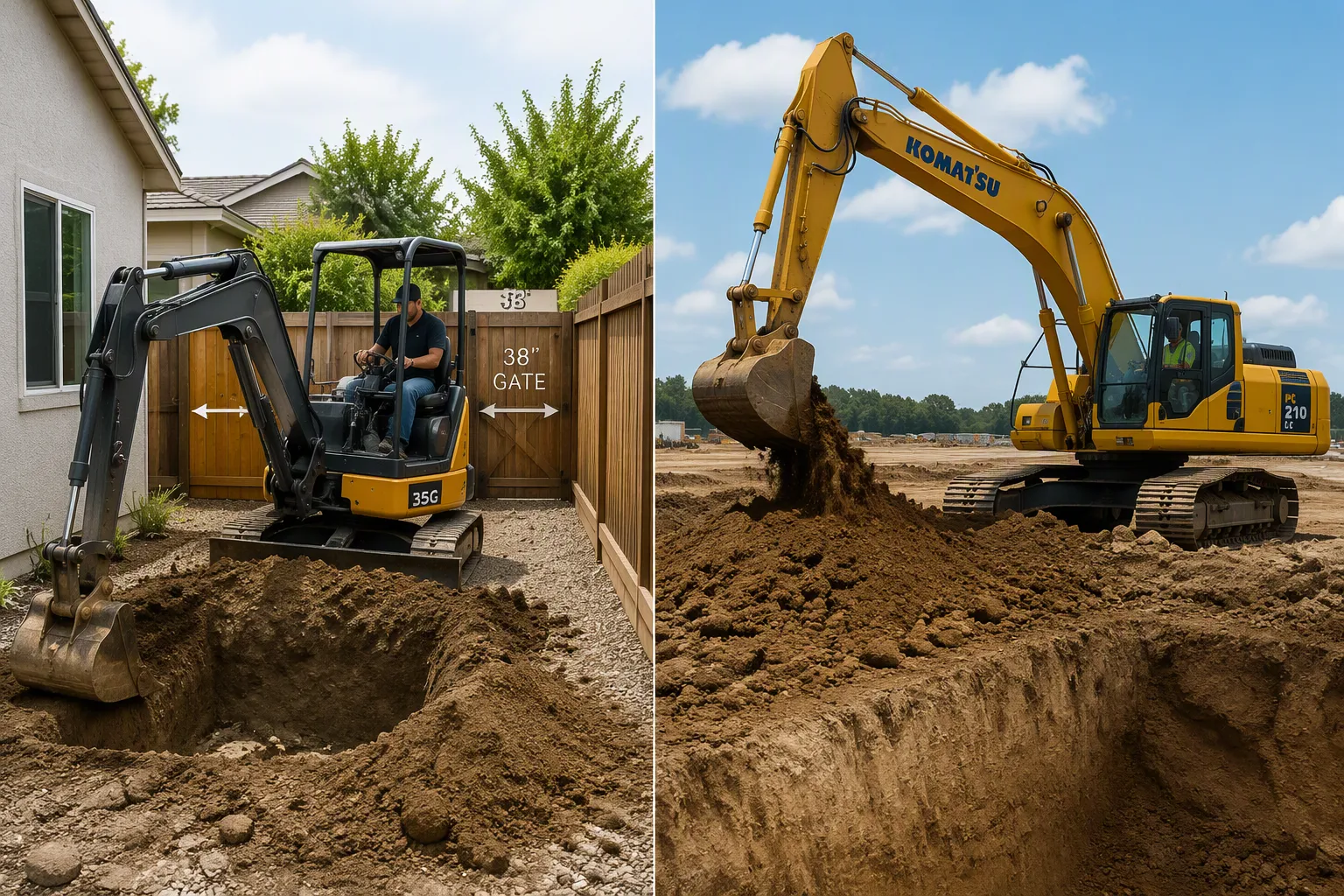
Backyard plunge pool (Phoenix) | 12 ft × 8 ft, excavated to 4 ft deep; 38-inch access gate | Pool excavation + floor grading (completed in ~6 hours) |
Irrigation trenching (Florida) | 200 linear ft of trenches, 8 inches deep | Trenching with 6-inch bucket (4 hours) + backfilling (2 hours) |
General residential tasks | Depths up to ~4.5 ft | Sprinkler/drainage trenches, shallow utility lines, sewer hookups, footings for sheds/garages/small additions, plunge pool/hot tub excavation, garden bed prep and grading |
These jobs share a common trait: tight access. A 20-ton machine cannot pass a 38-inch gate, and it cannot dig a 4-foot pool without damaging the surrounding yard. The mini class handles both constraints with ease. Landscaping, utility hookups, and small footings all fall inside its working envelope.
Utilization decides whether ownership makes sense. Annual usage for small-scale residential work clusters around a buy-versus-rent breakeven of roughly 1,000 operating hours per year. That figure equals about 15–20 rental days annually at approximately $200 per day. Below this threshold, renting stays cheaper than ownership. Above it, purchasing becomes the more economical choice. Idle capacity erodes value fast, so match machine size to expected hours per year.
Large-Scale and High-Volume Work
A 20-ton excavator earns its place on bulk earthmoving, demolition, and high-volume production. Its bucket capacity and breakout force move material at a rate no compact unit can match. Daily production on a bulk cut reflects that advantage directly. The larger machine also sustains that output across long shifts, which matters on infrastructure and site-development schedules.
The same logic applies to demolition and road construction. A large excavator breaks footings, removes rubble, and excavates roadbeds with hydraulic power that smaller classes cannot supply. Standard excavators in the mid-size range bridge some gaps, yet the 20-ton class remains the choice where depth, force, and output set the schedule.
Utilization works in reverse here. A 20-ton machine carries a high operating cost per hour, so idle time hurts more than it does on a mini. Contractors justify the premium by keeping the machine booked on volume work. A large excavator that sits between jobs drains profit quickly. Match the class to a steady pipeline of heavy work, and the numbers hold.
Mixed-Fleet Strategies
Owning both classes can be profitable for contractors serving mixed project portfolios. Compact excavators are increasingly treated as complementary assets within mixed fleets rather than niche tools. A small 2-tonne machine cannot replace a 7–10 tonne unit, yet it handles a wider range of tasks where access, control, and surface impact matter. Near existing services, finished structures, or restricted environments, it works more efficiently and with lower risk than larger machines.
Labor availability shapes these decisions. Experienced operators are scarce, and their preferences weigh heavily on equipment choice. Maintenance expectations have also shifted. Smaller contractors lack dedicated servicing staff, while larger organizations need maximum uptime with minimal intervention. Fewer operators can perform mechanical repairs, which raises demand for durable machines with accessible service points and onboard diagnostics.
A mid-sized road contractor leases a mix of crawler and mini excavators for different highway segments, scaling capacity up or down as project phases shift—an example of how mixed fleets support flexibility and asset-light operations. However, high upfront costs for next-generation excavators still limit adoption for smaller contractors, and shortages of skilled operators and maintenance crews delay rollouts in some developing regions.
A mixed fleet lets one contractor answer the question of which offers better value? on a per-job basis. The mini handles the confined work, and the 20-ton unit takes the volume. Each machine stays busy, and productivity across the portfolio rises. Operating costs stay proportional to the work each unit performs. That balance is the practical argument for running both classes.
ROI and Payback
Payback on Small Jobs
Small jobs reward a fast payback. A mini excavator carries a modest purchase price and low operating cost, so the machine recovers its price across a limited number of projects. A landscaper who bills trenching, footing, and drainage work at a steady day rate can track payback in seasons rather than years. The math stays simple: divide the purchase price by the profit each job returns.
Utilization sets the pace. Leasing becomes economical at roughly 80–120 annual use days, and financing or buying pays off at about 130+ days. A contractor below that line should weigh buying or renting with care. Idle hours on a compact machine still consume fuel, insurance, and storage. Those charges erode the return on a small job.
Payback on High-Volume Jobs
A large excavator costs far more upfront, yet its output shortens the payback window on volume work. Bulk earthmoving, demolition, and road construction generate revenue per hour that a compact unit cannot match. The machine earns back its premium through faster cycles and a larger bucket. A steady pipeline of heavy work keeps that return moving.
The risk sits in idle time. A large excavator that sits between jobs drains profit quickly, because its operating cost per hour runs high. Contractors protect the investment by booking the machine on long runs. A mid-size excavator break-even lands near 130–160 rental days per year. Above that threshold, ownership usually wins. Below it, the numbers favor a rental desk.
Rent vs. Buy Checklist
The purchase or rental decision turns on more than sticker price. Cash flow, tax treatment, maintenance burden, and flexibility all shift the answer. The table below lists the factors worth comparing before committing.
Checklist Factor | What to Compare (Rent vs. Buy) |
|---|---|
Cash flow impact | Buying = large upfront outlay; financing/leasing = moderate predictable monthly; renting = variable pay-as-you-go |
Tax treatment | Buying = depreciation plus interest deduction; leasing/renting = fully deductible operating expense |
Maintenance burden | Buying/financing = owner responsible; renting/leasing = lessor responsible |
Flexibility | Renting highest; leasing moderate; financing/buying lowest |
Break-even utilization | Leasing economical at ~80–120 annual use days; financing/buying at ~130+ days |
Equipment size and attachments | Mini excavators (1.5–3 tons) for tight urban spaces; full-size (18–22 tons) for open sites; renting allows switching sizes and specialty attachments |
Compliance and emissions | Rental fleets typically meet current Tier 4 standards; older owned units may face job restrictions |
Operator skill and training | Renting avoids model-specific training; owning amortizes training over years |
Project pipeline certainty | High month-to-month variance (over 30%) favors renting; a stable multi-year pipeline favors buying |
Inspection and condition (if buying) | Check hydraulics, undercarriage wear ($8k–$15k replacement), machine hours, and service records |
Two factors deserve extra weight. Pipeline certainty decides whether ownership cost spreads across enough work. Inspection decides whether a used unit holds its value. A machine with worn undercarriage can erase a year of savings. Buyers who check both lines protect the investment before signing.
Choosing the Right Supplier
Why Parts and Service Matter
Parts availability and service network strength affect uptime and total cost for either machine class. A machine that waits days for a hydraulic hose loses billable hours. A machine with a nearby dealer gets back to work fast. Major brands such as Hyundai, Caterpillar, and Komatsu stock parts at thousands of dealers worldwide. That reach improves parts availability and shortens repair waits.
Preventive maintenance protects the investment. A $200 service call avoided can become a $5,000+ repair. A small hydraulic leak ignored long enough becomes a failed cylinder at $2,500. Simpler systems with readily available parts mean fewer failures and less frequent mechanic visits. Responsive support matters too. A US-based support team that answers inquiries within 48 hours keeps a project moving. Service contracts and warranty coverage add another layer of protection. One-year parts and spares warranty plus free one-on-one email support included at purchase reduces risk on either class.
Sourcing Both Classes from Tianhengweiye
Tianhengweiye (Tianhengweiye Construction Machine Co., Ltd.) is a Hyundai construction equipment provider with over 25 years of experience. The company holds a large genuine-parts inventory and operates 50 branch locations across China. Buyers comparing a mini excavator against a large excavator can source both classes through one reliable supplier. That single point of contact simplifies parts ordering and service scheduling across a mixed fleet.
The company also handles special equipment modifications. Pile drivers, amphibious excavators, dismantling machines, and heavy-duty breaker arms let a buyer tailor either machine class to specific project needs. A contractor working wetlands can spec an amphibious unit. A demolition crew can add a breaker arm. These options extend the working range of each class without changing its core role.
Why global distributors choose Tianhengweiye:
Container loading expertise: Professional loading supervision ensures 3-4 mini excavators fit safely in one 40HQ container
Genuine Hyundai parts inventory: Over 10,000+ parts in stock for immediate global shipment
FOB/CIF/DDP terms: Flexible shipping options to 100+ countries with full documentation support
Custom modifications: Amphibious undercarriages, extended reach arms, specialized buckets
Tianhengweiye presents a neutral sourcing path: the mini stays the choice for confined work, and the 20-ton unit stays the choice for volume. A supplier carrying both classes helps match the right machine to the job.
Ready to Optimize Your Equipment Investment?
Get a free container loading analysis, FOB quote, and customized fleet recommendation from Tianhengweiye - Your trusted Hyundai excavator partner for over 25 years.
Get Your Custom Quote →When to Choose Each Machine
Choose a Mini Excavator
A mini excavator is the right pick when the site itself sets the limit. Narrow gates, finished lawns, basements, and crowded urban lots all reward a compact footprint. Retracted tracks bring the width down to roughly 39 inches, so the machine passes openings a full-size unit cannot approach. Rubber tracks protect pavement and turf, and a zero-tail-swing design lets the operator work beside walls without striking them.
The workload should also stay modest. Trenching, drainage, footing work, landscaping, and utility hookups fit inside the working envelope. Check dig depth against the planned depth with a safe margin, and confirm that the hydraulic system can run any attachment the job needs. Engine power matters here, since demanding attachments draw on it. Budget, financing, and resale value round out the decision. When access and maneuverability decide the plan, the mini class usually wins.
Choose a 20-Ton Excavator
A 20-ton excavator fits medium-to-heavy earthmoving, demolition, and high-volume production. The class balances breakout force with standard lowboy transportability. Confirm the boom and stick configuration before committing: a standard stick suits utility trenching, a long-reach front suits dredging and sloping, and a mass excavation setup handles heavy rock loading. Auxiliary hydraulic flow decides which breakers, shears, and grapples the machine can run.
Ground pressure deserves a hard look. Track width must match the terrain, with wider shoes for soft ground and narrower shoes for hardpack. Verify that digging depth exceeds the planned depth with margin, and that discharge height matches truck bed height. Parts support and service reach protect uptime. On a used unit, inspect the undercarriage, hydraulics, slewing ring, and engine before signing. Where volume and force set the schedule, this class earns its cost.
Final Decision Checklist
Run the screen in order. Project scale and site access narrow the field first, then performance and cost confirm the pick. The table below summarizes the deciding factors.
Question | Points to a mini | Points to a 20-ton unit |
|---|---|---|
Can the machine reach the work zone? | Tight gates, backyards, basements | Open ground, wide access |
What daily output does the job need? | Modest volume, precision work | Bulk earthmoving, demolition |
What does transport involve? | Standard container / light trailer | Ro-Ro vessel / heavy haul rig |
How many hours per year? | Low hours favor rental | Steady pipeline favors ownership |
The best job fit comes from matching machine to job, not from brand loyalty. Compare mini excavators against standard excavators on these four lines, and the answer usually becomes clear. A large excavator that sits idle loses money, and a mini pushed past its depth limit loses time. Neither outcome answers which offers better value? for your project. Weigh scale, access, and utilization, then commit.
Value comes from fit, not from size alone. Mini excavators are the economical pick for small-scale, confined projects. A 20-ton machine delivers better value when high volume justifies the higher cost. The practical takeaway is the smallest efficient machine rule. Choose the smallest unit that finishes the job efficiently.
Assess project scale, site access, and utilization before you decide. These three factors settle most equipment choices. A supplier carrying both classes can help. Tianhengweiye offers the Hyundai equipment range with genuine parts support across 50 branch locations. Request a rental quote or speak with a specialist to match the right excavator to your job.
FAQ
How deep can a mini excavator dig?
Depth depends on machine size. Micro units reach 6–8 ft, utility units 8–12 ft, and compact units 12–16 ft. The overall mini range tops out around 11–15 ft. Check your planned depth against the machine's rating and leave a safety margin.
How much fuel does each class burn per hour?
A mini excavator uses roughly 1.5–3.5 gallons per hour. A large excavator uses 4–7 gallons per hour. The gap compounds across a full season of work.
Can a 20-ton excavator fit into a residential backyard?
Rarely. A 20-ton machine measures about 8 feet wide. Retracted tracks on a mini bring the width down to roughly 39 inches, narrow enough for a personnel door. Tight gates and finished lawns favor the compact class.
How many mini excavators fit in a shipping container?
Typically 3-4 mini excavators (3-5 ton class) fit in one 40HQ container. Larger 6-8 ton minis fit 2-3 units. This container efficiency makes minis ideal for distributors building diversified inventory.
How much can I save by buying used?
A used mini excavator can cost 30–50% less than a new machine. Inspect hours, undercarriage wear, hydraulic leaks, and service records before committing. A well-maintained unit can offer strong value.
When does renting beat buying?
Leasing becomes economical at roughly 80–120 annual use days. Financing or buying pays off at about 130+ days. Below those thresholds, rental usually wins. Idle hours still consume fuel, insurance, and storage.
Do I need a special license to tow a mini excavator?
Usually not. A Class A CDL is only required when the combined GVWR of the towing vehicle plus trailer exceeds 26,000 lbs. Most mini excavators paired with a pickup and trailer stay well under that threshold.
Which machine offers better value for a mixed project portfolio?
Owning both classes can be profitable. Mini excavators handle confined work, and a 20-ton excavator takes the volume. Each machine stays busy, and operating costs stay proportional to the work performed.
What should I check before buying a used excavator?
Inspect the undercarriage, hydraulics, slewing ring, and engine. Verify service records and machine hours. Undercarriage replacement can run $8,000–$15,000, so worn tracks can erase a year of savings.
Does Tianhengweiye ship internationally?
Yes. Tianhengweiye exports to 100+ countries with FOB, CIF, and DDP shipping terms. They provide professional container loading supervision and full documentation support for international orders.
Get Your Free Equipment Consultation
Let Tianhengweiye's specialists help you choose the right excavator for your project. Get container loading plans, pricing, and logistics support within 24 hours.
Contact Us Now →Recent News
1.Hyundai 22–30 Ton Excavator Reliability: Uptime Facts for Fleets
2026-10-092.Hyundai Excavator Modification: Don't Void Your Warranty
2026-09-283.Hyundai HX305VL: China Stage IV Mining Excavator
2026-10-154.Hyundai HX130: Urea-Free China Stage IV Excavator
2026-09-305.Standard vs. Customized Excavator: Which Is Right for Your Project?
2026-10-13


